
Capture critical knowledge before it’s lost
CogniCache is AI-powered knowledge transfer software that captures expert knowledge, turns it into structured assets, and makes internal AI & on- and offboarding more effective.
Run AI-guided interviews to extract expert knowledge, automatically transcribe it, and publish structured knowledge items for AI & teams in minutes, not hours.
*In a free, short session, we give a demo & clarify your use case, key risks, and the right pilot path.
What is CogniCache? Founder Andy gives you the 80-second intro.

Compliant & Secure

Strategic & Efficient

User-Centric & Smart
Critical expertise is like gold dust: precious, yet easily lost. CogniCache extracts critical expertise and transforms it into structured data.
Capture Wisdom.
Empower the Future.
CogniCache is a compliant AI knowledge capture tool for organizations that need reliable knowledge transfer. It helps teams capture expert knowledge through guided interviews, structure it automatically, and reuse it for various use cases like on- and offboarding, and internal AI systems.
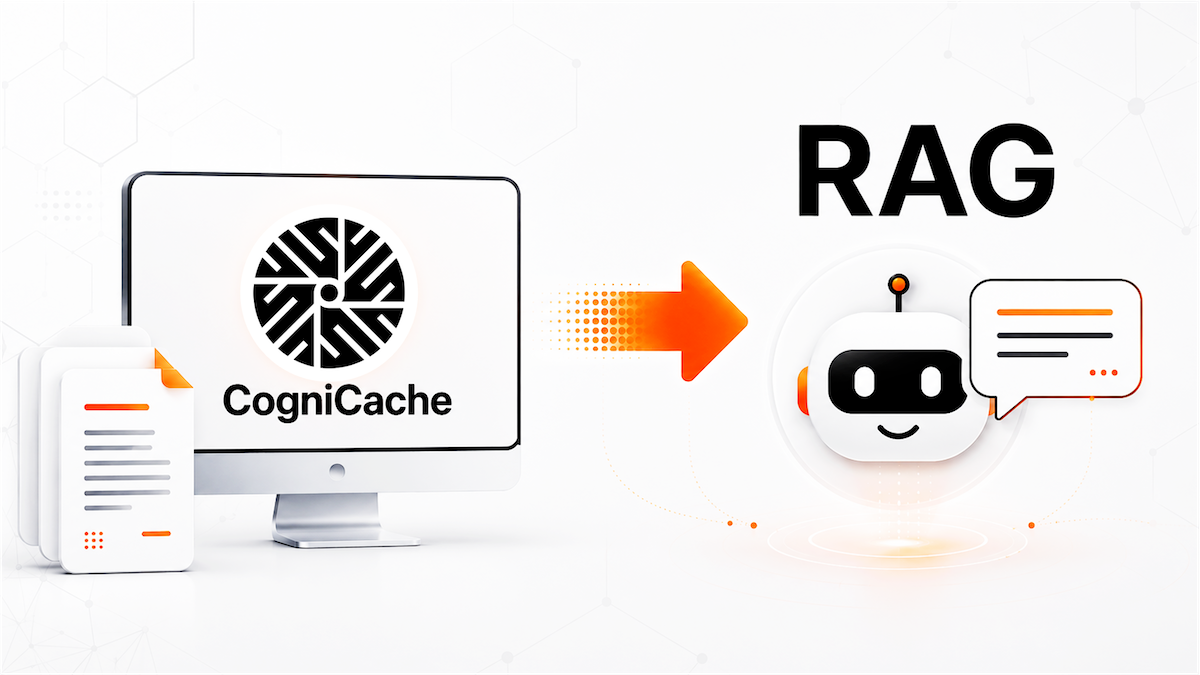
AI is only as good as the knowledge behind it.
CogniCache turns hidden expertise into structured, AI-ready knowledge powering use cases like RAG and intelligent chatbots. Without high-quality, structured input, even the best AI falls short. CogniCache closes that gap.
CogniCache helps you with these and many more use cases...

People & Expertise Retention
Transfer know-how during expert offboarding: Preserve critical know-how before key employees leave to ensure continuity and avoid disruptions.
Enable customer support: Capture frontline expertise from support teams and make it available to others for faster issue resolution.

Project & Process Intelligence
Capture project knowledge without manual overhead: Standardize how wrap-ups, lessons learned, processes, and decisions are captured—without manual overhead.
Optimize your processes: Identify inefficiencies by analyzing captured knowledge and surfacing actionable improvement suggestions.

Collaboration & Knowledge Flow
Make knowledge transfer work across teams: Prevent duplicated work by making insights from one team easily accessible across the organization.
Structure your innovation memory: Document relevant knowledge of current R&D initiatives and avoid reinventing the wheel.

Compliance & AI Enablement
Get ready for compliance checks & audits: Generate content for structured documentation effortlessly to meet audit and regulatory requirements.
Create structured knowledge for internal AI: Create the structured knowledge your AI-enabled systems need to create high-quality output.
CogniCache is designed with data protection, security, and responsible AI in mind, taking into account regulations such as GDPR, the EU AI Act, the EU Data Act, and relevant US state privacy laws.It works as a standalone knowledge capture system or as a knowledge extraction layer that feeds Confluence, Google Workspace, Notion, SharePoint, and other knowledge platforms.
Visit our dedicated Landing Pages to get a quick overview.


Or watch our intro videos with Thomas.
Watch the 2-minute teaser.
Watch the 9-minute explainer.
$47M lost each year!
Large U.S. companies lose $47M annually due to poor knowledge management & sharing. - Source
30% of productivity lost
Companies lose up to 30% of their productivity due to lacking or difficult to find knowledge. - Source
Don’t be one of them!
Be different and use CogniCache to retain know-how while making it ready for AI systems.
Share CogniCache
Why CogniCache?
When critical expertise isn’t captured, organizations pay the price.
Teams lose decades of know-how when experts leave, repeat mistakes that were already solved, and waste time rediscovering knowledge that once existed.These aren’t rare edge cases — they’re everyday risks of uncaptured tacit knowledge. That's why we built CogniCache after experiencing firsthand how often critical knowledge disappears or gets rediscovered at high cost.CogniCache exists to stop this by preserving hidden expertise and turning it into structured, accessible knowledge teams can rely on.

Tacit knowledge is your real competitive advantage. CogniCache makes this hidden expertise visible, reusable, and valuable.

Preserve Valuable Institutional
Wisdom
Ensure critical employee insights and expertise are retained and made available company-wide to enable learning and growth across siloes.

Boost Innovation & Decision-Making Processes
Turn core expertise into structured, evolving organizational knowledge — aligned with how your company works and accessible to everyone who needs it.
"Data is the new gold — Create structured documents using CogniCache to fuel the future."

Get Actionable Insights from your Knowledge
Well-structured documentation with key insights enable you to get actionable recommendations to optimize your knowledge and improve daily work.

Motivate your Teams to Document Knowledge
Guided, intuitive interviews and automated processing make knowledge capture effortless — transparent rewards boost participation and motivation.
Who CogniCache Is Built ForCogniCache is designed for organizations where critical expertise lives in people’s heads, especially:
Knowledge-intensive teams where decisions, context, and experience matter
Organizations with high turnover or role changes, risking knowledge loss
Distributed or multinational teams struggling to share expertise consistently
Specialized professional services (consulting, engineering, product, R&D)
Innovation-driven teams where learning and iteration must be preserved

How CogniCache captures Expert Knowledge
1. Plan Interview
Select an existing template or start from scratch by defining your topics and participants.
CogniCache generates a structured, tailored interview guide based on your organization’s domain, terminology, and established approaches, as well as your role.
You can review, adjust, and refine everything easily.

2. Conduct Interview
Engage in a single or group interview guided by an intuitive AI assistant— through voice or chat. Unlike simple transcribers, CogniCache’s AI doesn’t just record; it asks smart follow-up questions, explores topics from multiple angles, reasons over responses, and structures the output into clear, usable insights.
3. Receive Results
CogniCache transcribes, summarizes, and structures your captured knowledge into clear, organized documents. You can review and adjust to ensure correctness and completeness. Once finished integrate the output into your existing knowledge bases.

Capturing critical team expertise has never been easier!
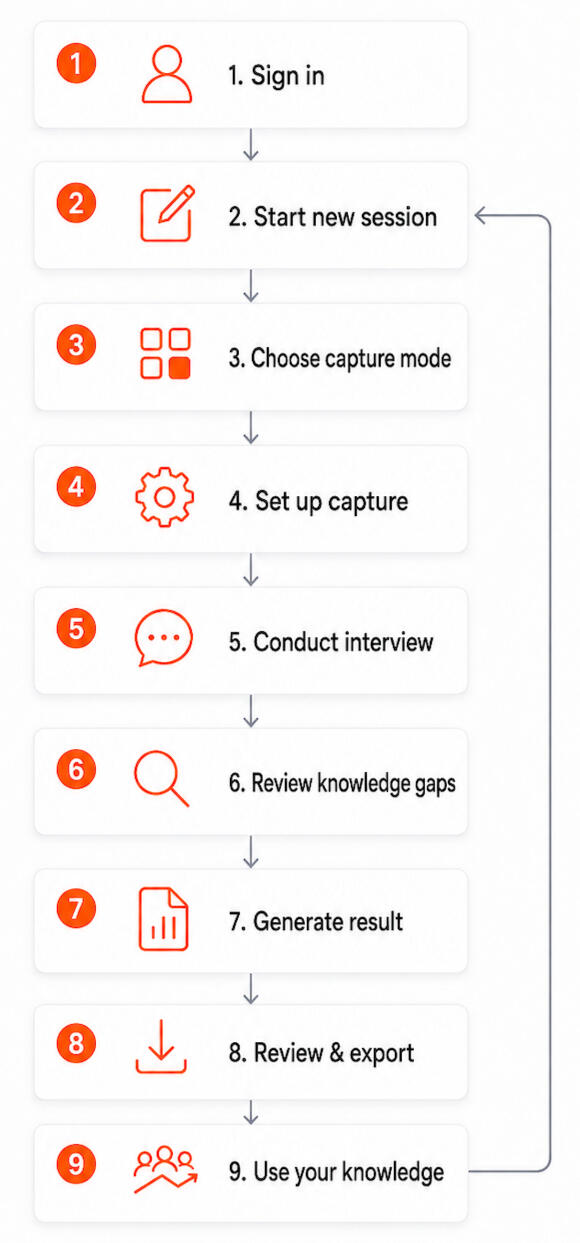
With CogniCache it is easy and intuitive. Just follow these 9 simple steps guided by our AI assistants to capture critical expertise and transform it into reusable knowledge:
Sign in: Access CogniCache through your organization.
Start new session: Create a new knowledge-capture session.
Choose capture mode: Select a template or start without one.
Set up capture: Use a ready-made template or let CogniCache help you define a tailored capture guide.
Conduct interview: Capture critical expertise through chat or voice, guided by the AI interview assistant.
Review knowledge gaps: Identify missing information and close relevant gaps through targeted follow-up questions.
Generate result: Transform the completed interview into a structured, reusable knowledge artifact.
Review & export: Review the generated result and export it for further use.
Use your knowledge: Bring the structured output into your knowledge base, AI/RAG solution, or other downstream systems.
Repeat the process anytime to keep your organizational knowledge fresh, accessible, and actionable. Further you can define and review key metrics. Over time get personalized suggestions to optimize your knowledge and daily work based on the captured insights.
What is CogniCache?
CogniCache is not another wiki, repository, or blank-page editor.
It is AI-powered knowledge transfer software that captures expert knowledge and turns it into structured, reusable knowledge assets.
Through guided conversations grounded in your organization’s terminology and practices, CogniCache surfaces the why behind decisions—including context, exceptions, and real workflows—making critical expertise explicit and reusable.
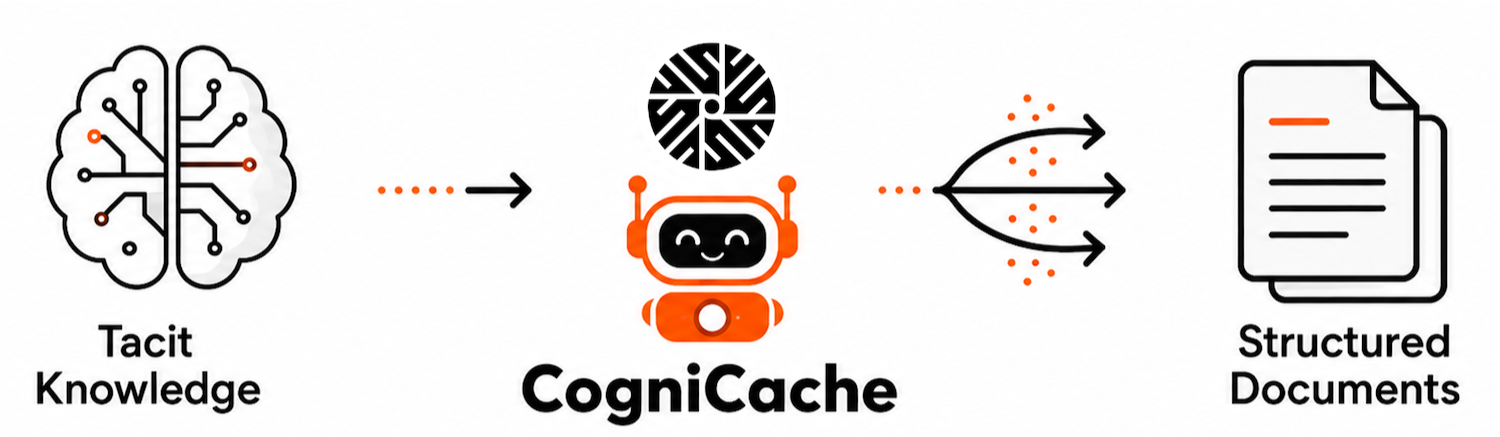
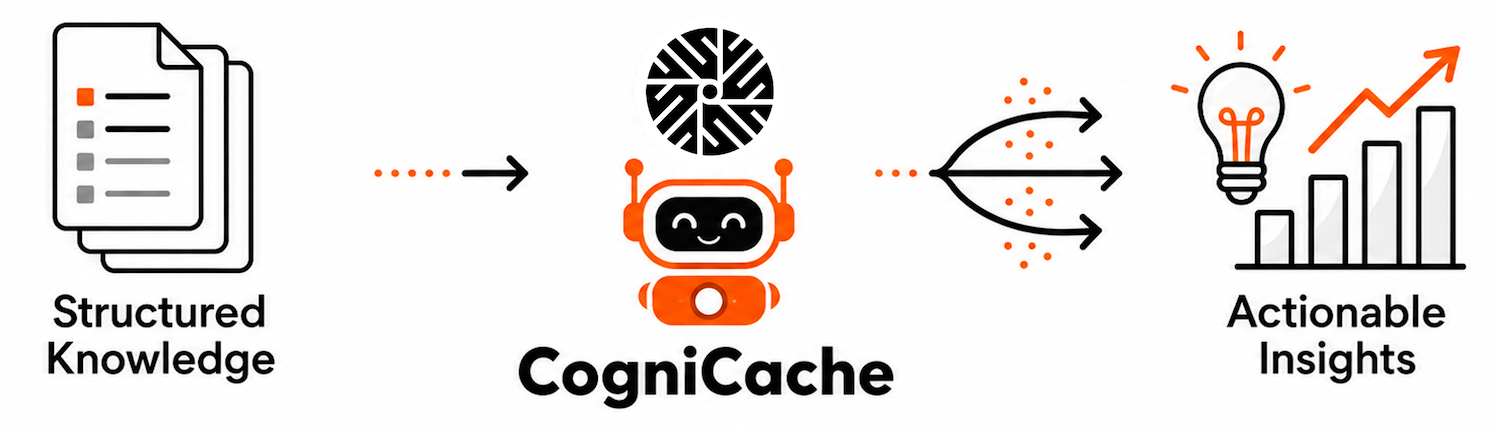
CogniCache complements existing knowledge systems rather than replacing them.
Grounded in proven methods for eliciting tacit knowledge, it creates an AI-ready knowledge foundation teams can analyze, improve, and build on over time. CogniCache was built by an experienced team with deep corporate backgrounds who faced knowledge loss and repeated work firsthand—and set out to solve it.
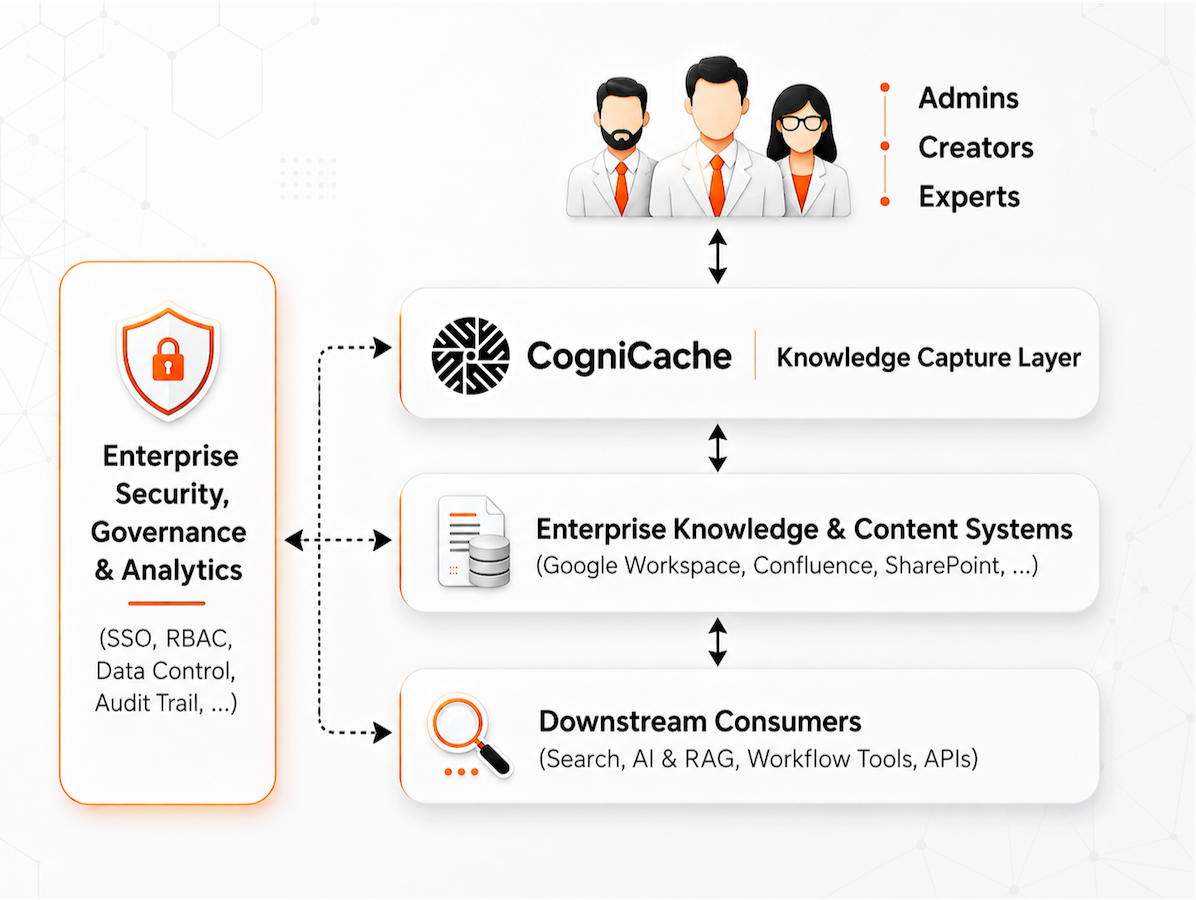
CogniCache fits into your existing knowledge ecosystem — securely and responsibly.
Use CogniCache standalone or as a dedicated capture layer for Confluence, Notion, SharePoint, Google Workspace, and internal AI systems. By capturing tacit expert knowledge systematically, it improves knowledge quality, search, and downstream AI performance without disrupting existing workflows.
CogniCache is designed with data protection, security, and responsible AI in mind, considering leading EU, UK, and US requirements and frameworks including GDPR, the EU AI Act, and ISO 27001.
Without CogniCache
Knowledge is recorded, not actively extracted.
Tacit know-how, context, exceptions, and decision logic remain hidden.
Capture quality depends on individual prompting and interviewer skill.
Knowledge remains fragmented and inconsistently structured.
Gaps, actionable insights, and opportunities for improvement stay largely undiscovered.
With CogniCache
Knowledge is extracted via guided AI interviews.
Tacit know-how, context, exceptions, and decision logic are surfaced systematically.
Specialized interviewing and targeted gap reviews drive consistent, high-quality capture.
Knowledge becomes structured, reusable assets with clear review and traceability.
AI-derived insights highlight workflow improvements and what knowledge to capture next.
Why CogniCache instead of a general AI assistant?ChatGPT, Copilot, and Claude are general-purpose tools. CogniCache is purpose-built for expert interviewing, gap detection, structured knowledge capture, and actionable insights. It guides the full workflow, adapts to your terminology and templates, and gives you a specialized solution without having to build and maintain one yourself.
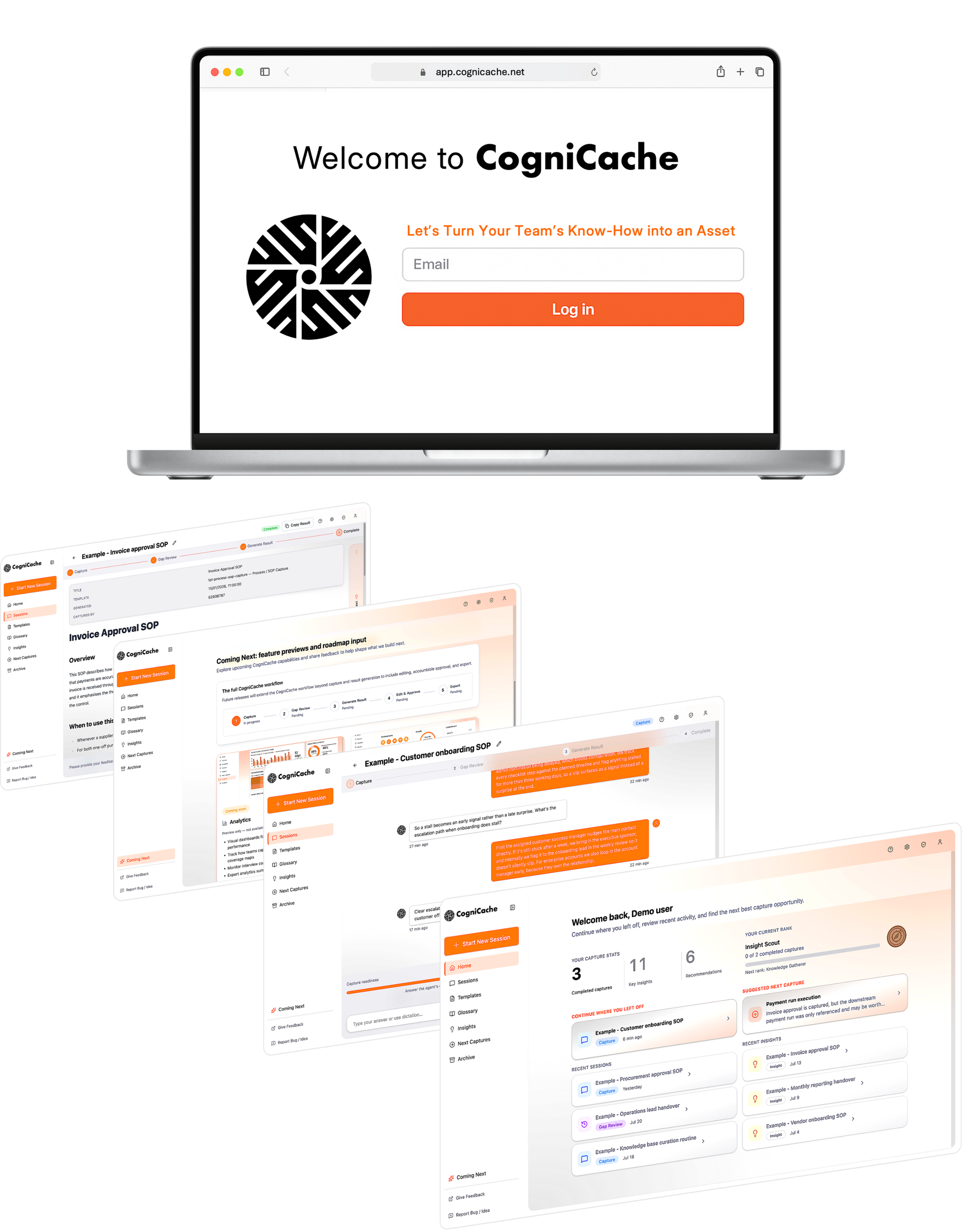
Capture better knowledge. Put it to work.CogniCache features a clean, intuitive design that guides you seamlessly from knowledge capture to exploration and continuous improvement with these core capabilities:
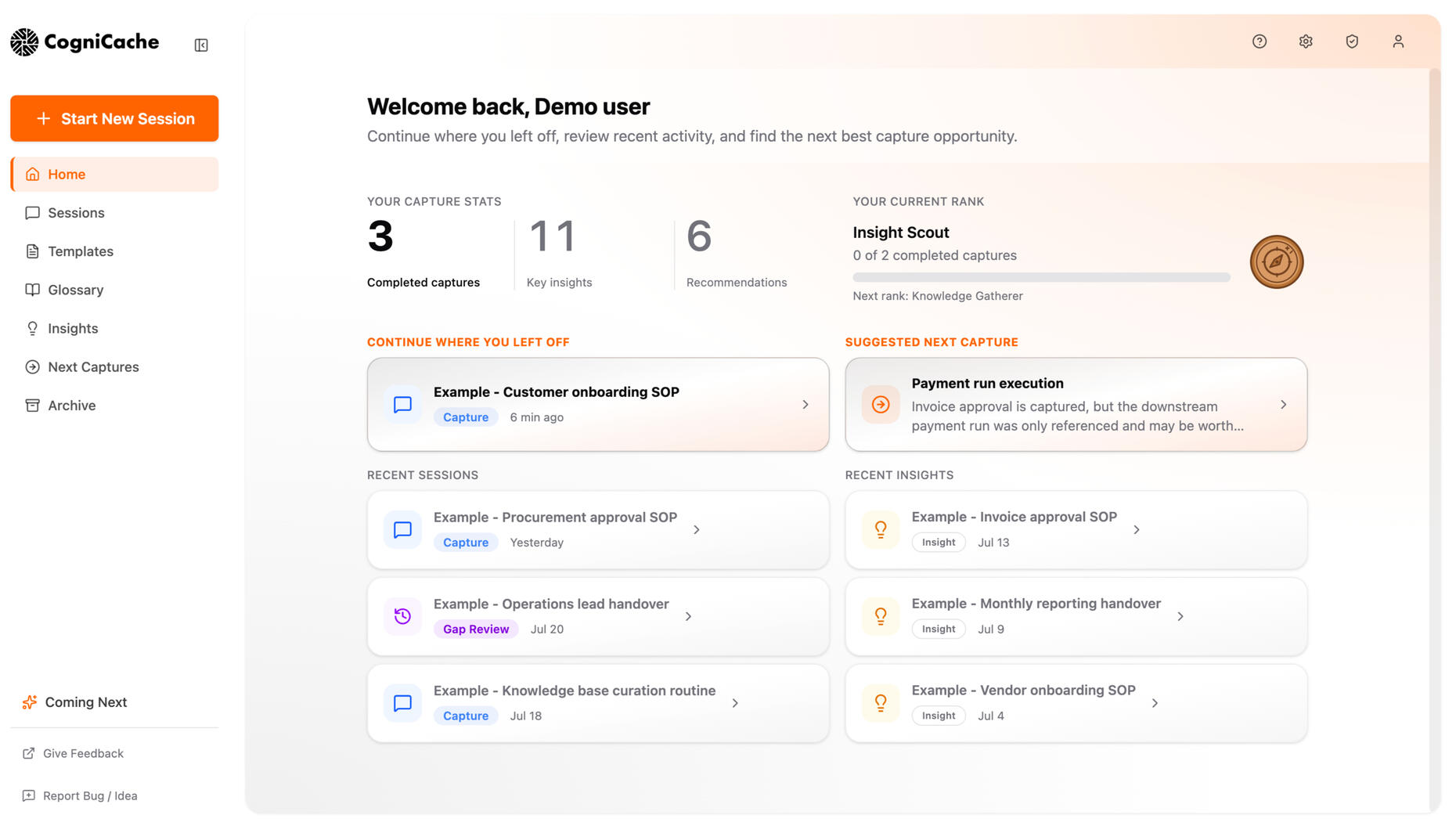
Stay oriented and act faster with everything important in one place.
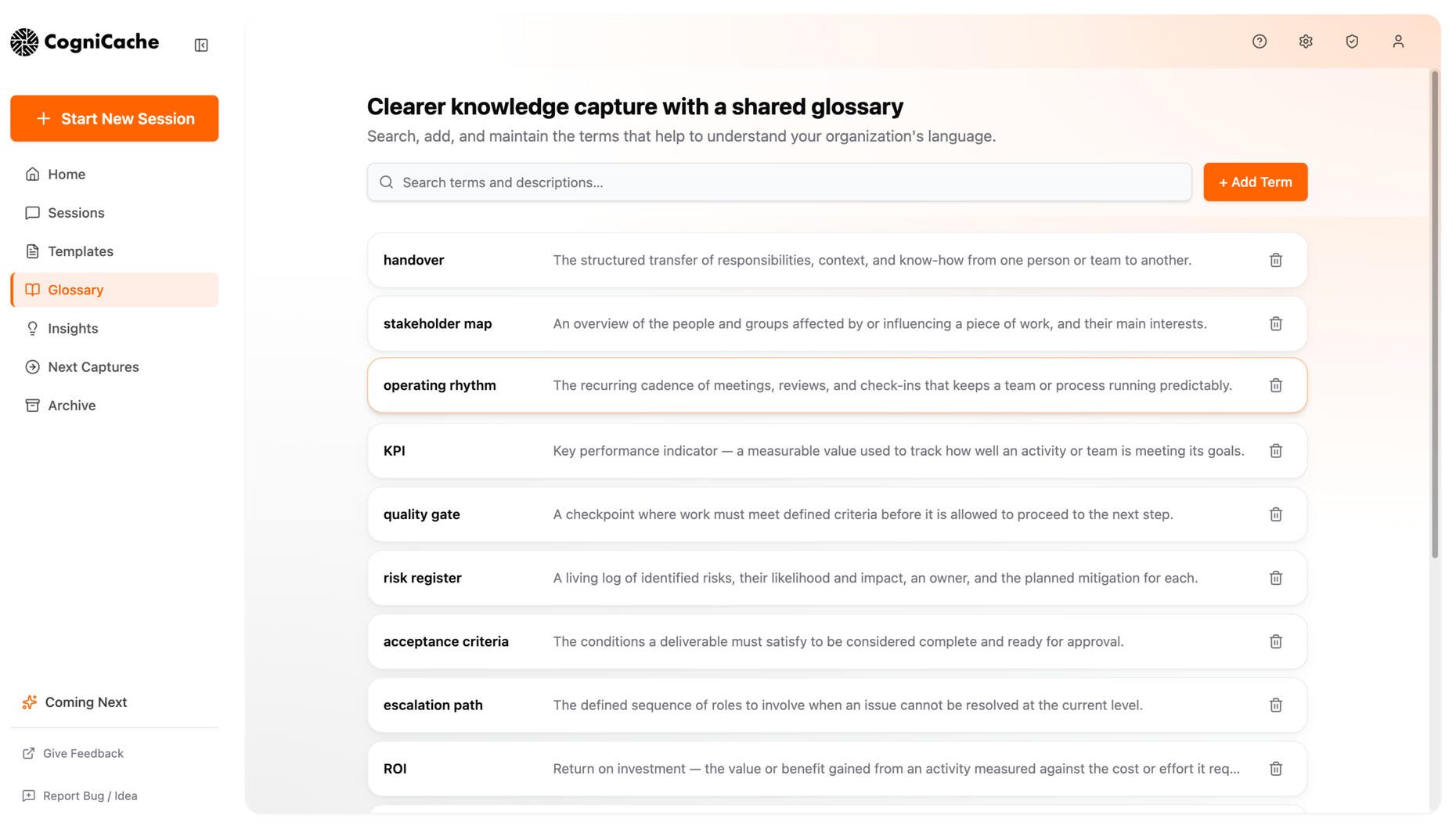
Capture more accurately by teaching CogniCache your company’s language.
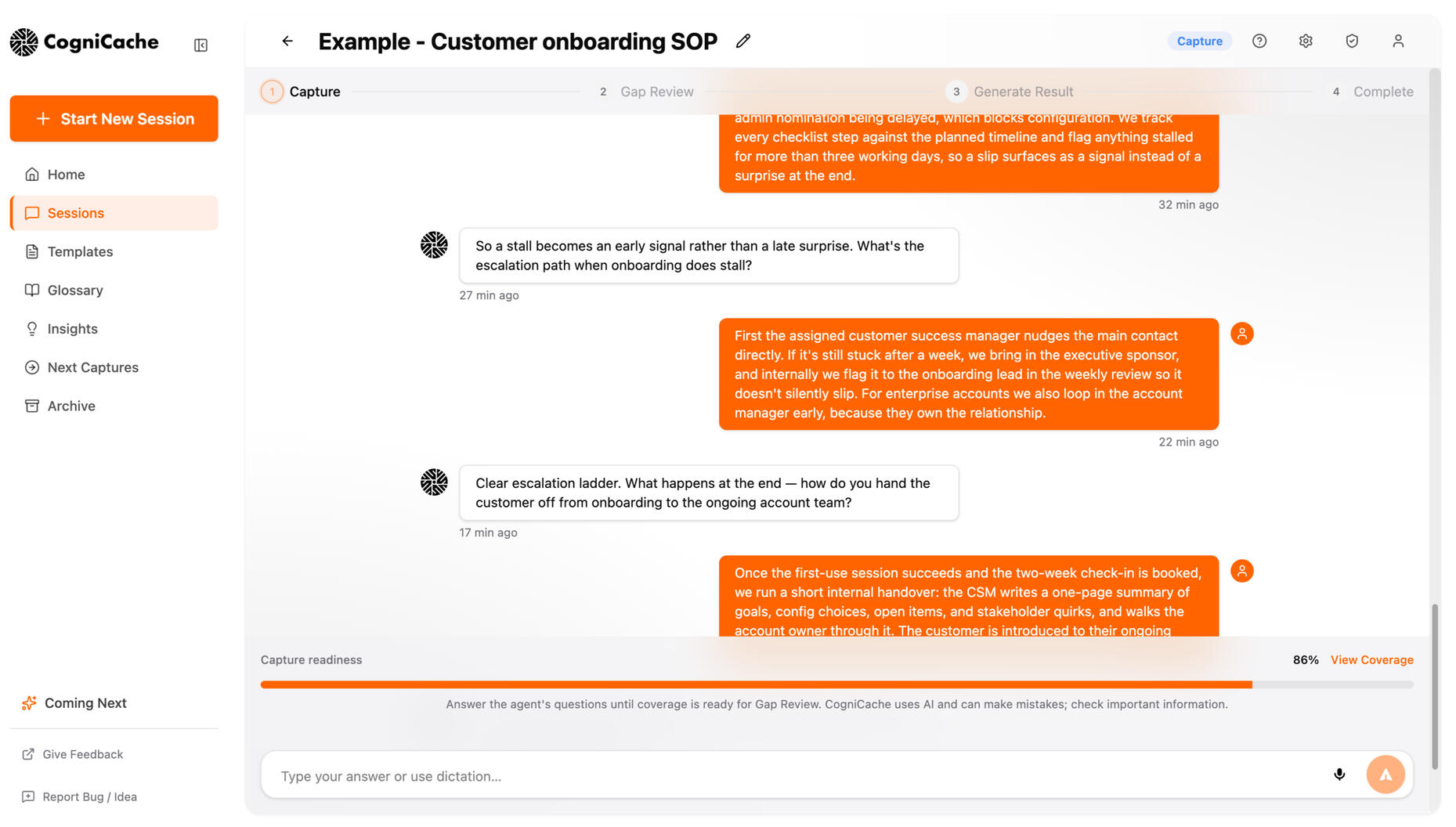
Surface deep expert know-how with guided capture and transparent progress.
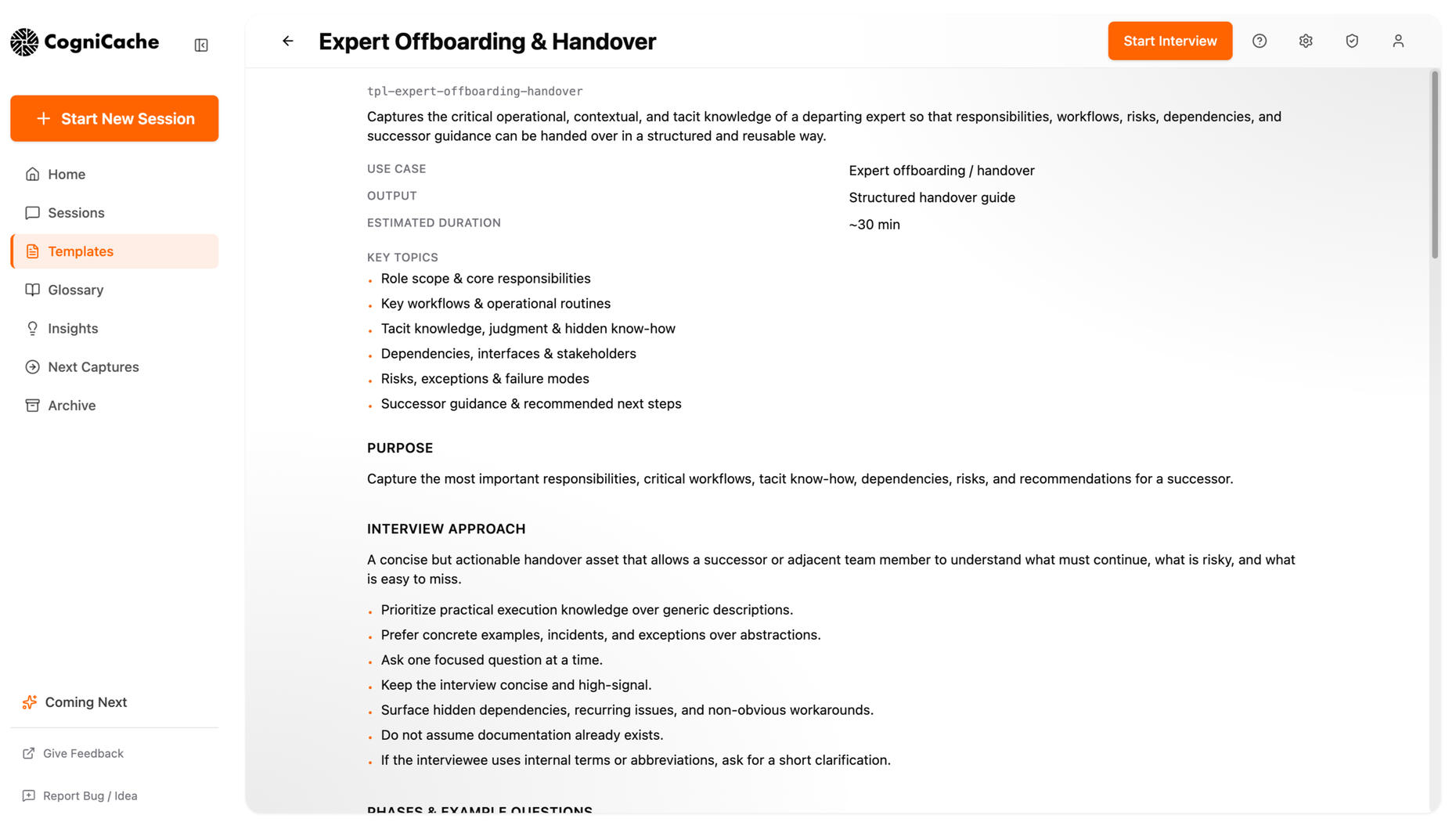
Capture consistently with proven templates or adapt freely when needed.
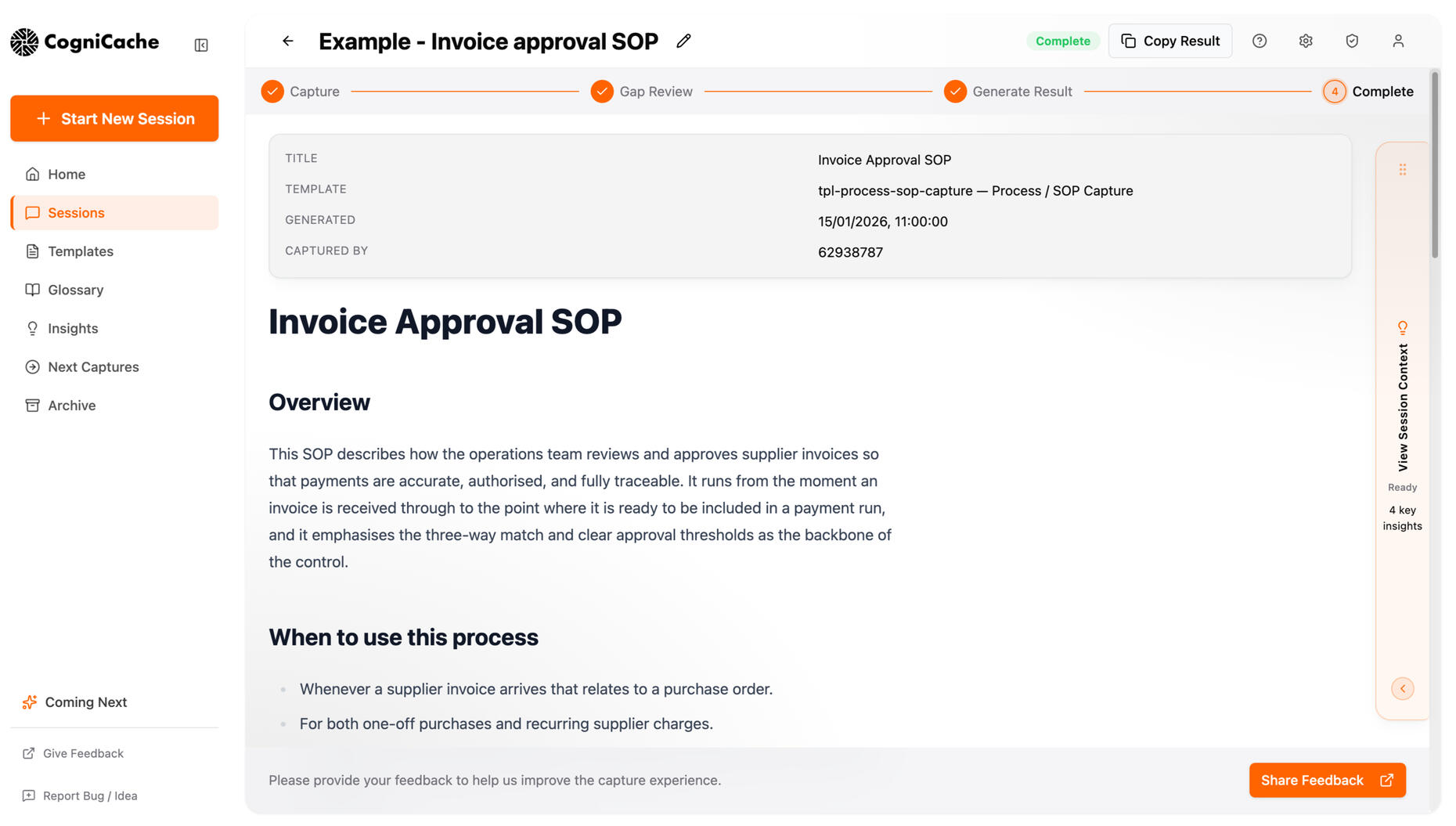
Turn conversations into knowledge that is easy to review, reuse, and share.
Learn from captured knowledge to improve workflows and decide what to capture next.
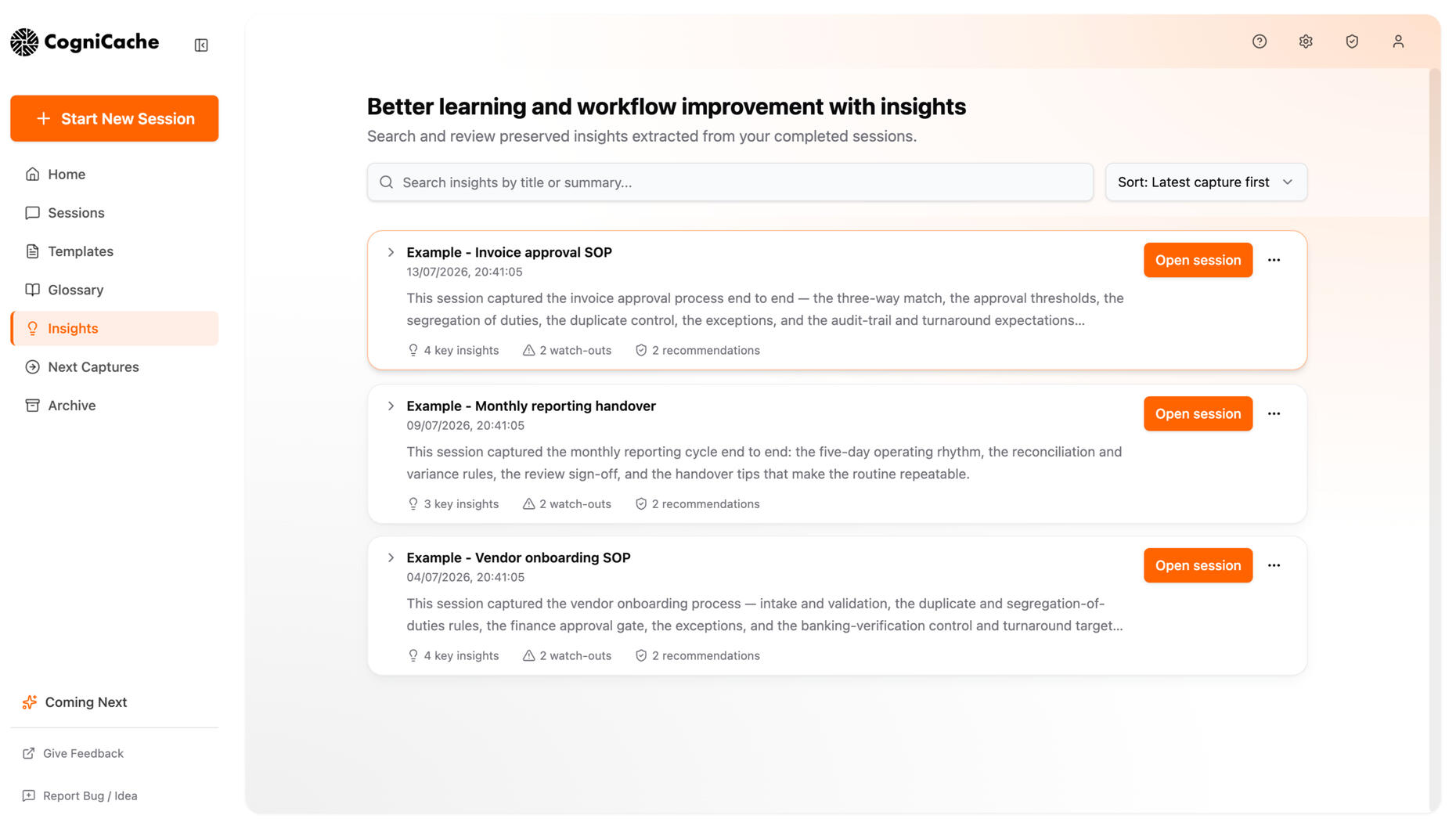
What’s next for CogniCache.These planned capabilities are already on the roadmap to make knowledge capture even more efficient and impactful:
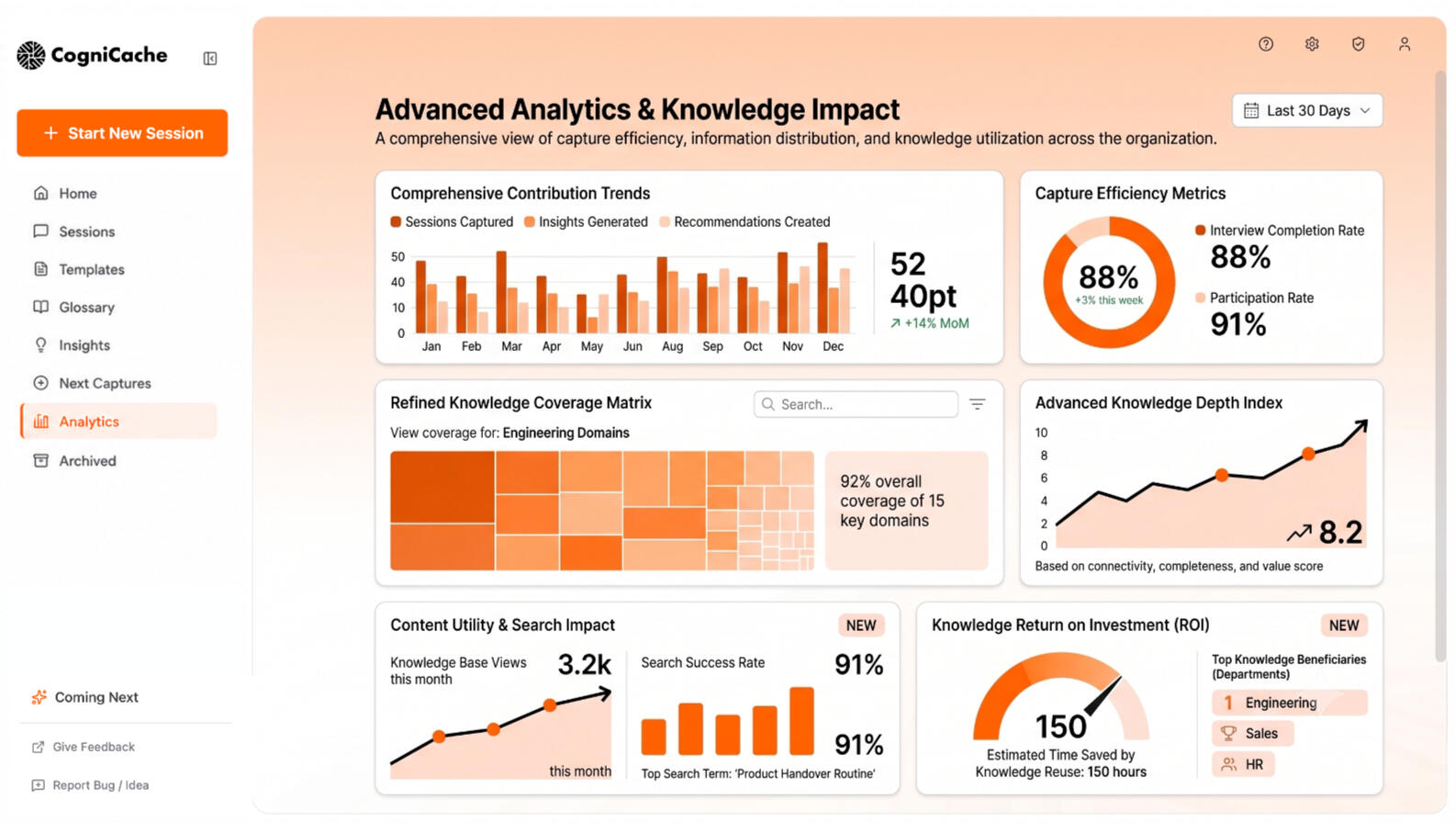
Know what to capture next, uncover knowledge gaps, and strengthen your knowledge base.
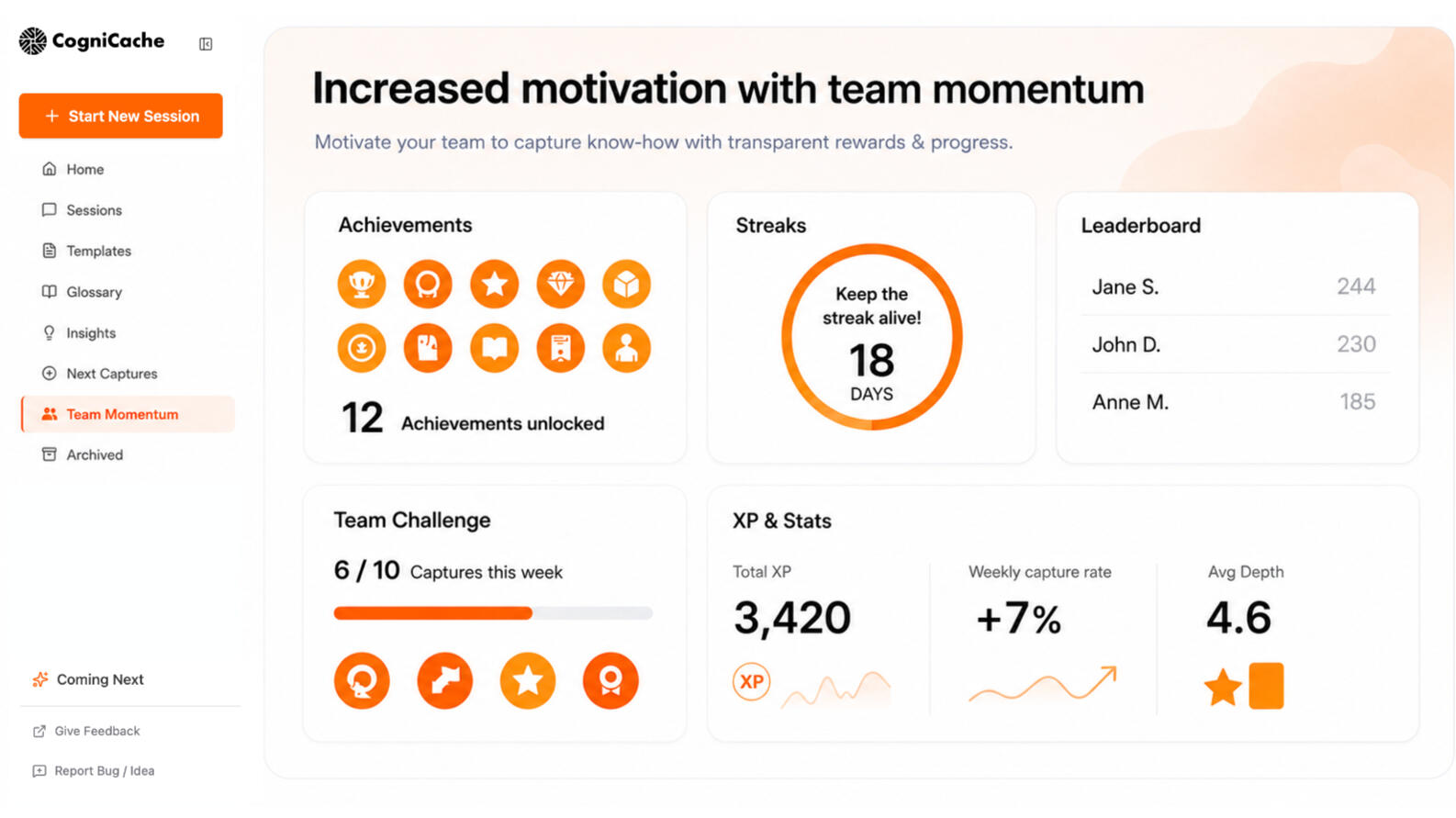
Motivate teams to capture knowledge consistently and keep your knowledge base growing.
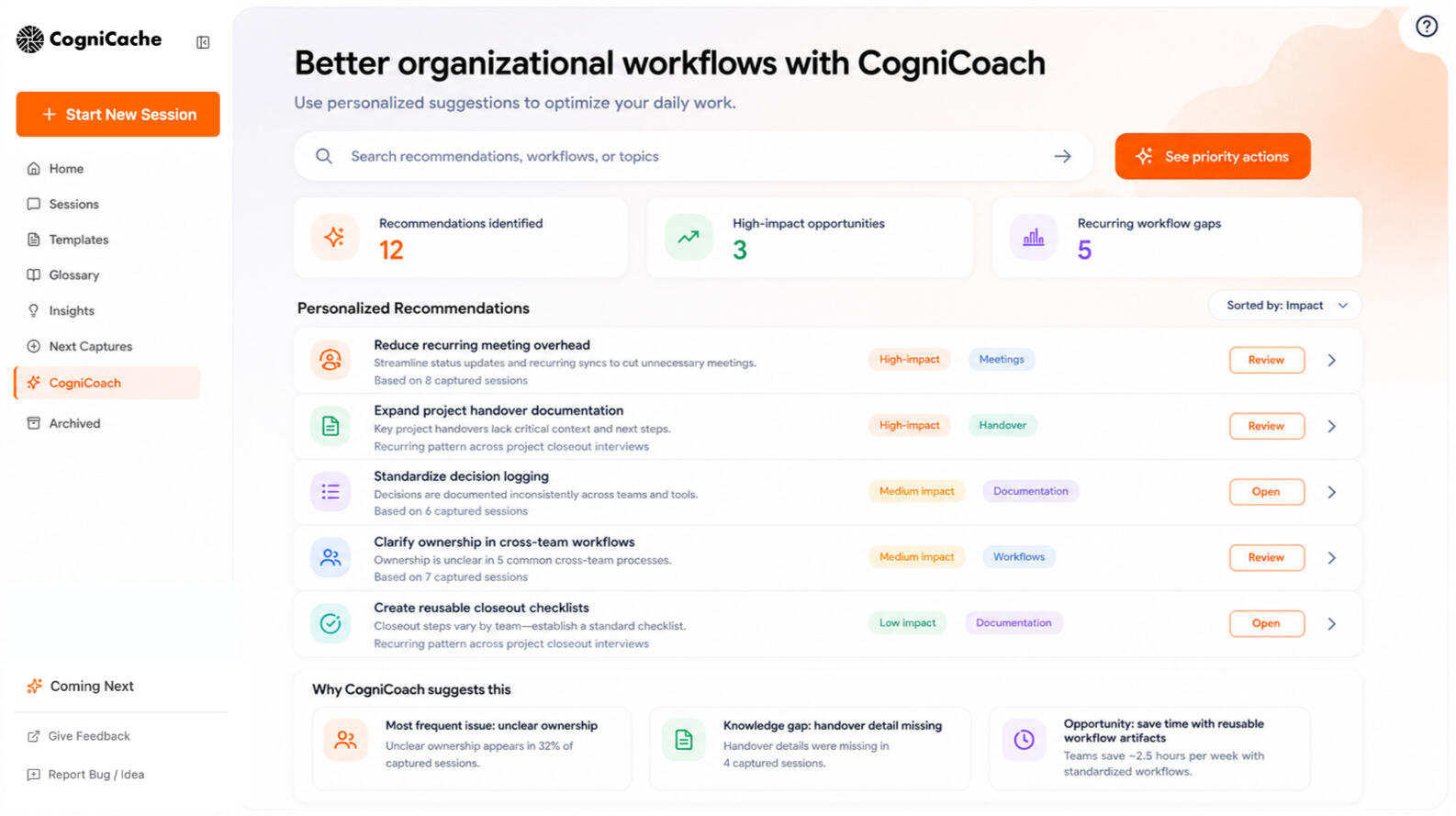
Improve daily work and workflows with recommendations grounded in your organization’s knowledge.
How can you get the most out of CogniCache?
To get maximum value from CogniCache, make knowledge capture part of your existing workflows, for example project wrap-ups, retrospectives, handovers, or expert offboarding, rather than treating it as an isolated activity.
Start by defining clear ownership and KPIs: what knowledge should be captured, who is responsible, and what success looks like. A Knowledge Admin can prioritize capture, while a Knowledge Creator maintains templates and runs interviews with subject-matter experts.
Then establish a simple cycle: embed → measure → capture → reward → repeat. Capture critical expertise consistently, recognize participation through visibility, progress, or gamification, and feed the structured results into systems such as SharePoint or Confluence. Over time, this turns knowledge capture into a repeatable process that continuously strengthens the organization’s knowledge base.
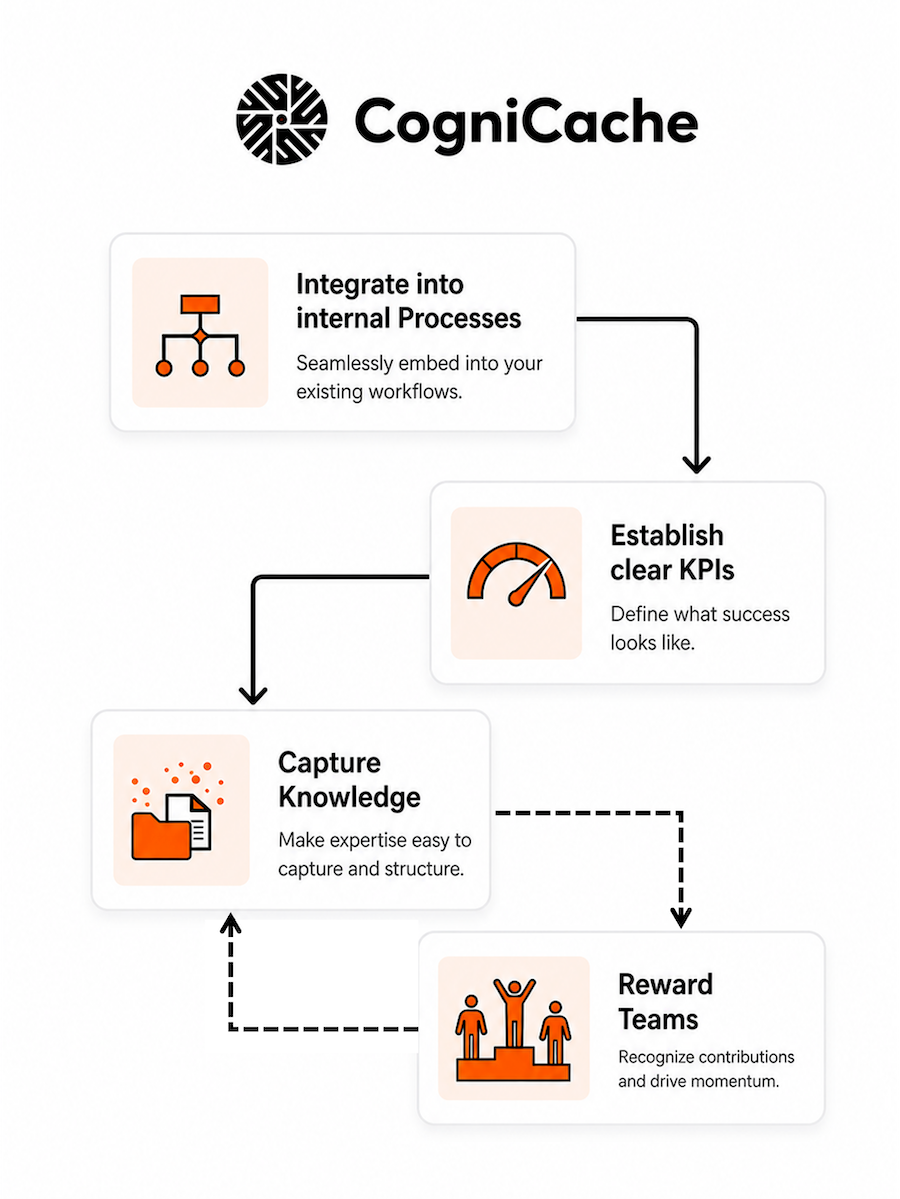
Preserve Knowledge
When experts leave, critical knowledge leaves with them.
Without systematic capture, organizations risk poor handovers, lost context, repeated mistakes, and operational disruption. Preserving expertise protects continuity and helps teams build on what already works.

Unlock Expertise
When knowledge stays siloed, teams repeat the same work.
Employees waste time solving problems others have already solved. Making expertise reusable reduces duplication, accelerates decisions, and turns past experience into an organizational advantage.

See for yourself!
Explore a step-by-step workflow to successfully conduct an interview and discover an exemplary output.
Validated Through Experience, Market Data & Industry Conversations
We didn’t guess what organizations need.CogniCache is shaped by firsthand experience with knowledge loss, in-depth research, real market data, and direct conversations with subject-matter experts and enterprise leaders.
Firsthand Experience: We experienced knowledge loss, repeated work, and difficult knowledge transfer ourselves across corporate, startup, and research environments.
Real Market Data: We tested the problem with real audiences and search behavior across LinkedIn and Google, generating 66,000+ impressions and 1,000+ clicks and identifying clear interest around knowledge loss, knowledge transfer, and expert knowledge capture.
Industry Conversations: Direct discussions with knowledge managers, SMEs, and enterprise representatives confirmed recurring challenges around tacit knowledge loss, fragmented documentation, and low-friction knowledge capture.
CogniCache is built around these validated needs.
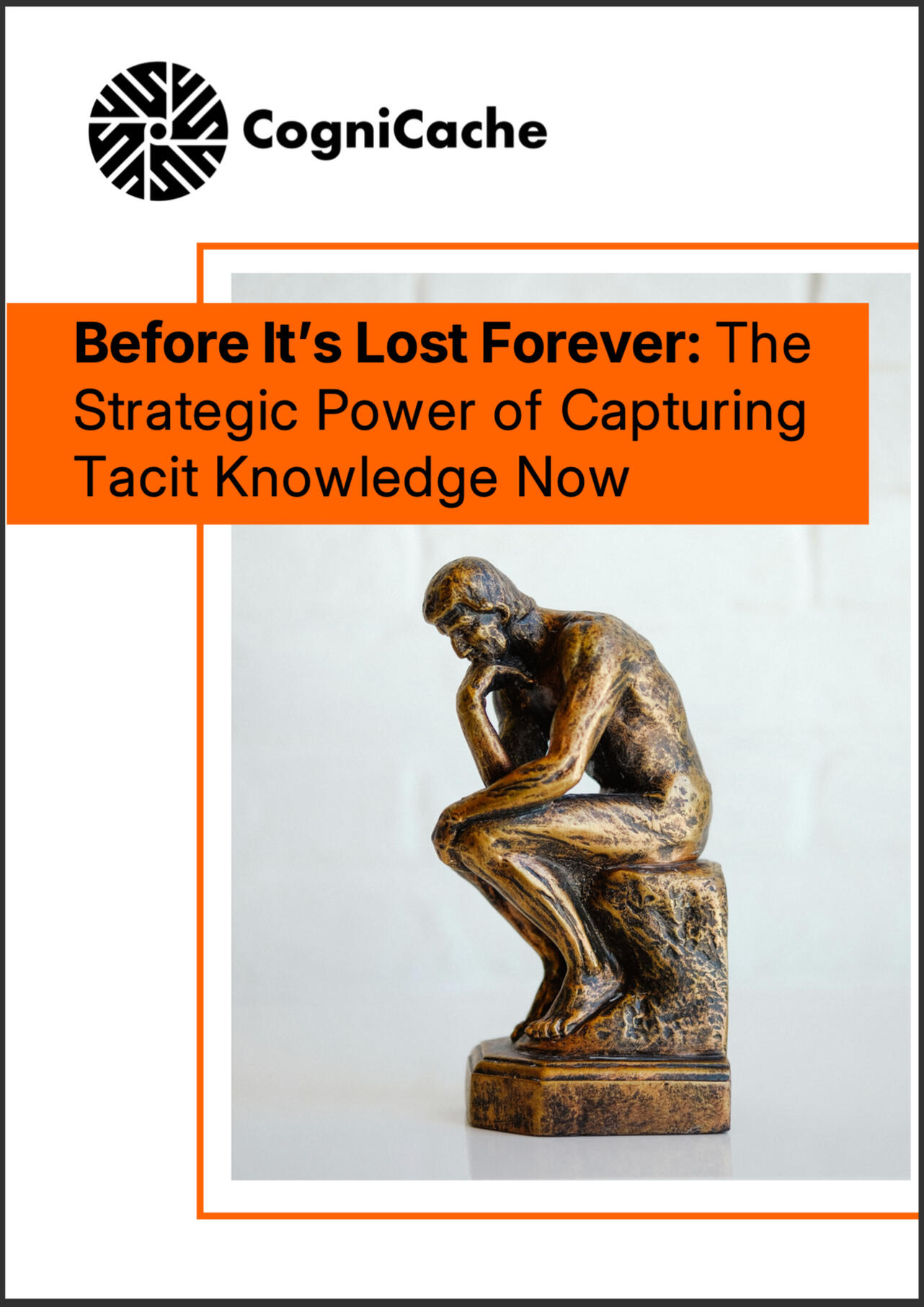
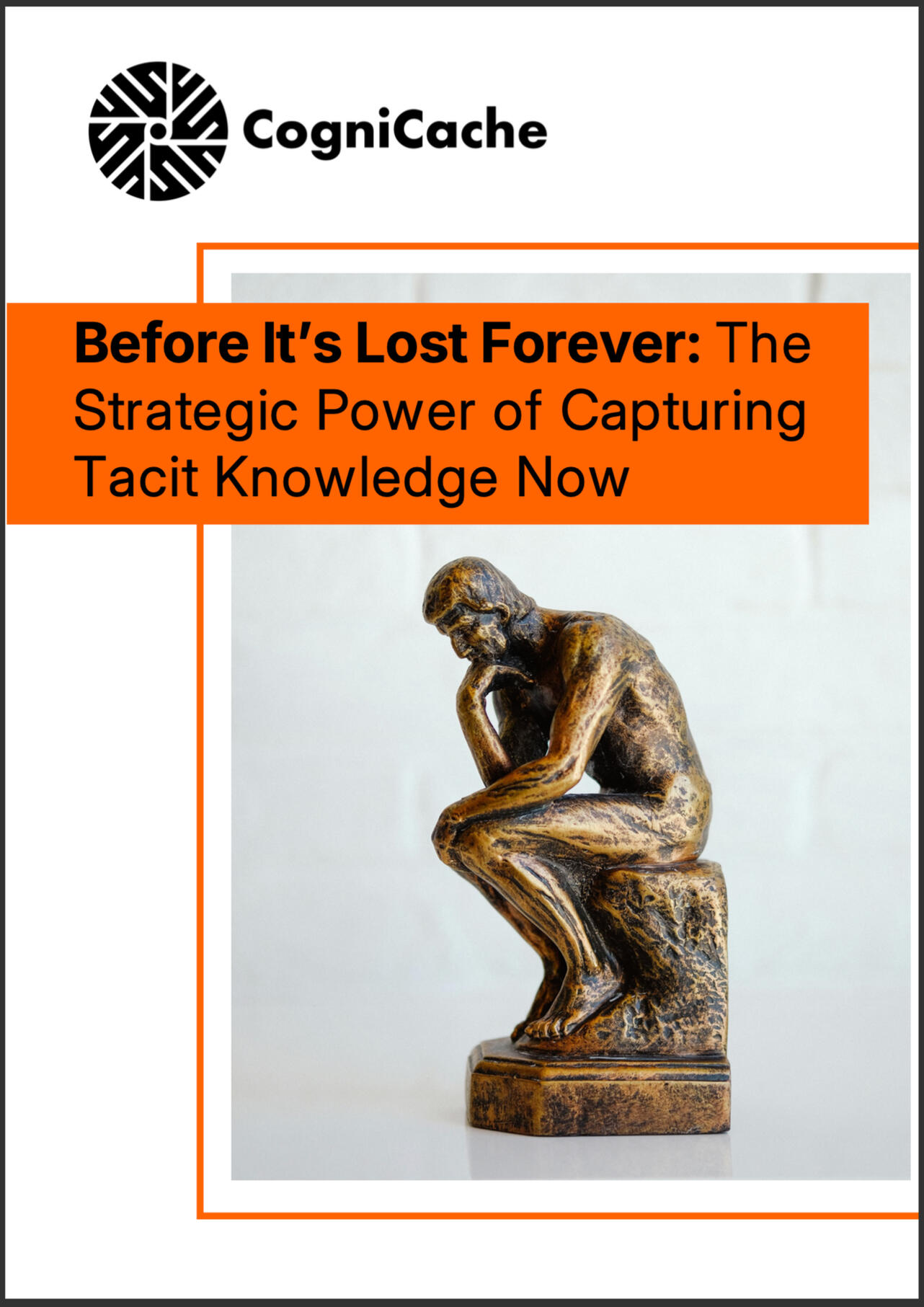
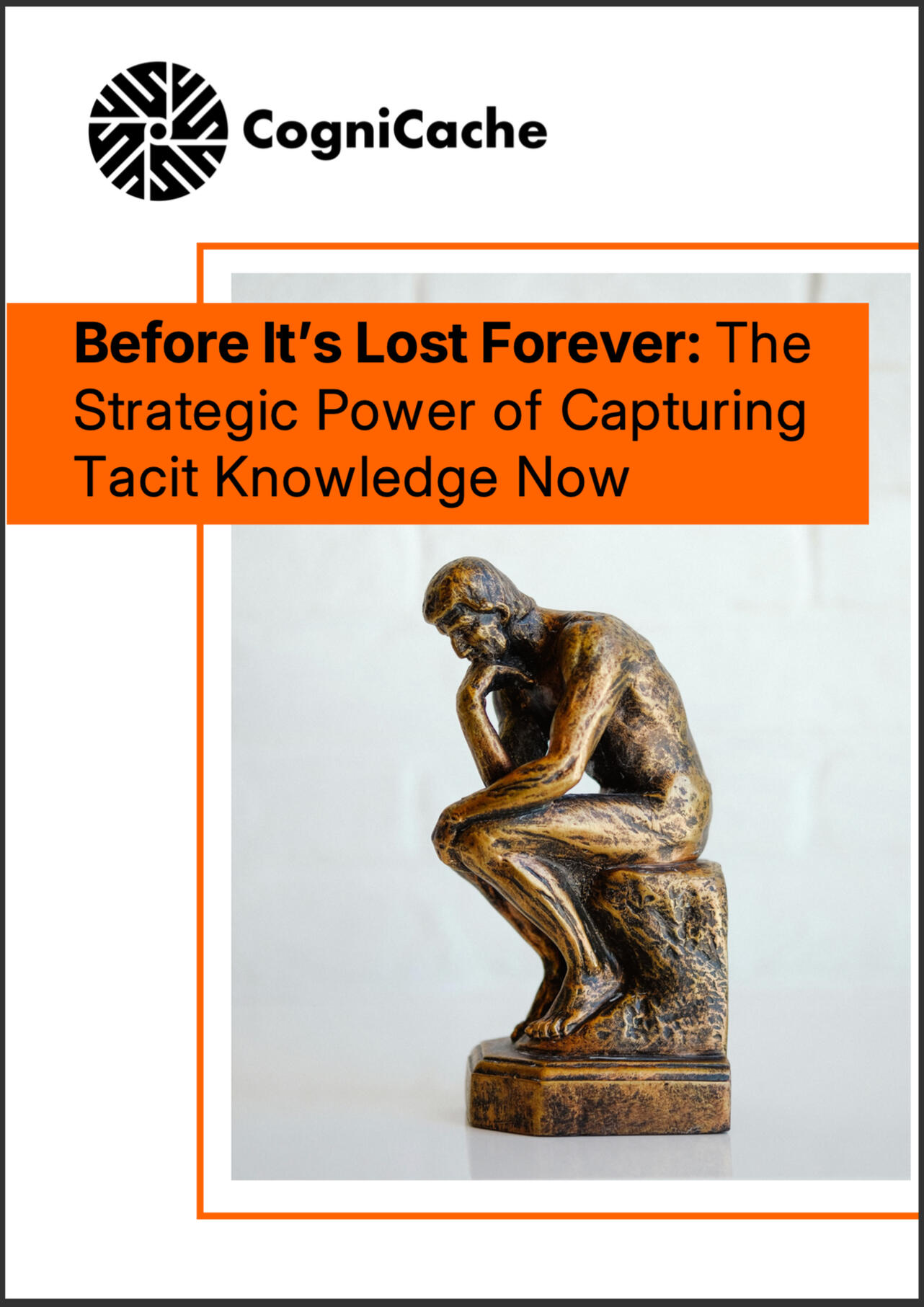
Get Our Free CogniCache Report
Download the CogniCache Report
"Before It’s Lost Forever: The
Strategic Power of Capturing
Tacit Knowledge Now"
and explore some key insights below.
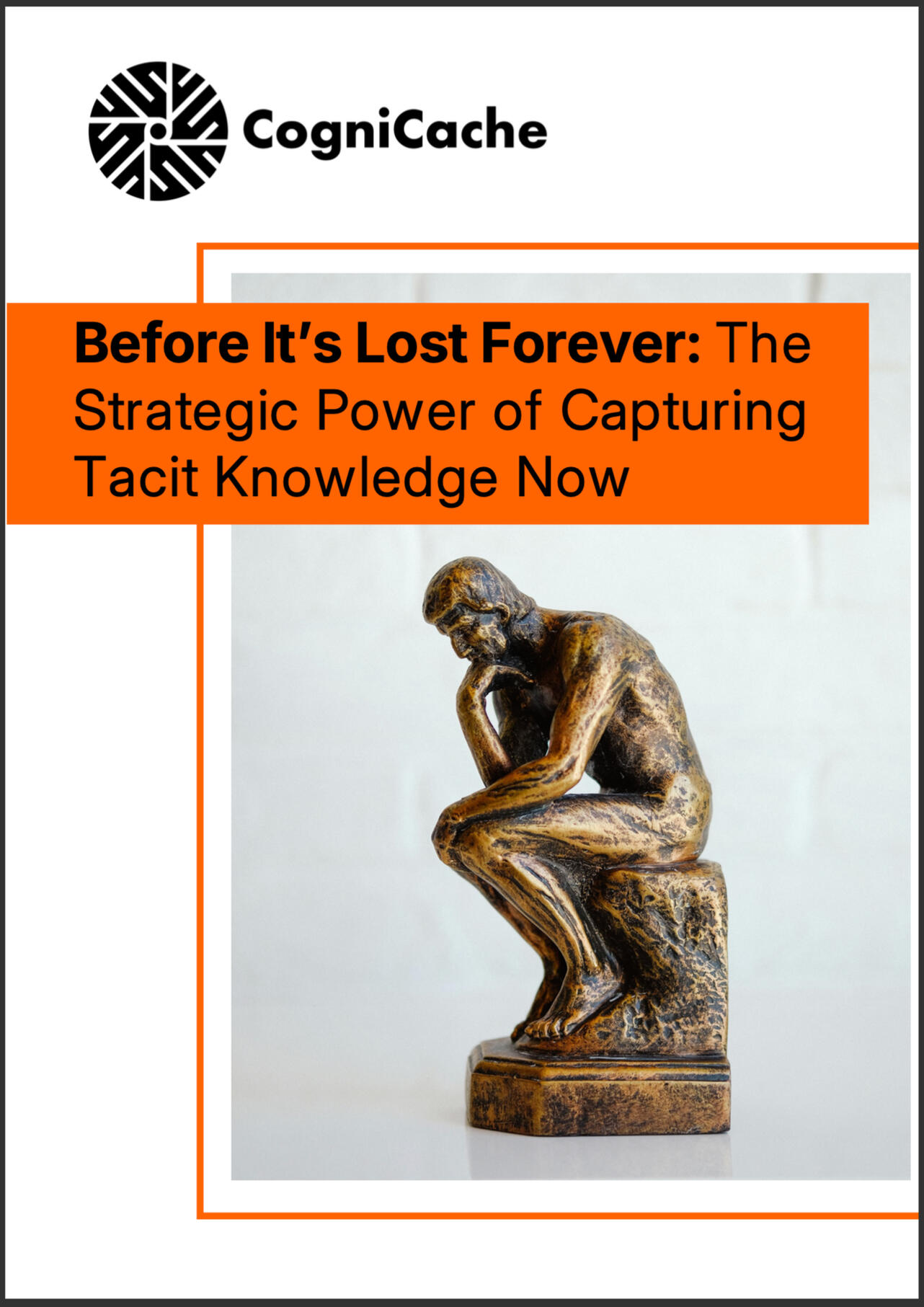
What happens when critical knowledge walks out the door?
The report explores the hidden costs of knowledge loss—and how organizations can prevent it. With up to 30% of work time lost searching for information and millions wasted in duplicated effort, the need to capture and structure internal know-how has never been greater. You'll discover why tacit knowledge is a strategic asset, how it fuels AI systems like Retrieval-Augmented Generation (RAG), and what it takes to build a culture of knowledge continuity.
64% reported loss of knowledge
67% of IT leaders are concerned about the loss of knowledge and expertise when employees leave. 64% of organizations reported they have indeed suffered knowledge loss due to people leaving.
42% of knowledge is unique
Approximately 42% of institutional knowledge is unique to individual employees, making it inaccessible to others when those employees are unavailable or leave the organization.
85% agree that unique
knowledge is critical
85% of employees agree that preserving and sharing unique knowledge is critical to productivity, implying that when it’s not done, productivity suffers broadly.
Companies lose roughly 20% of productivity
Companies lose roughly 20% of productivity due to knowledge inefficiencies – a figure that effective KM can significantly cut down.
Listen to a 20-minute summary of the report right here.
Why is CogniCache unique?
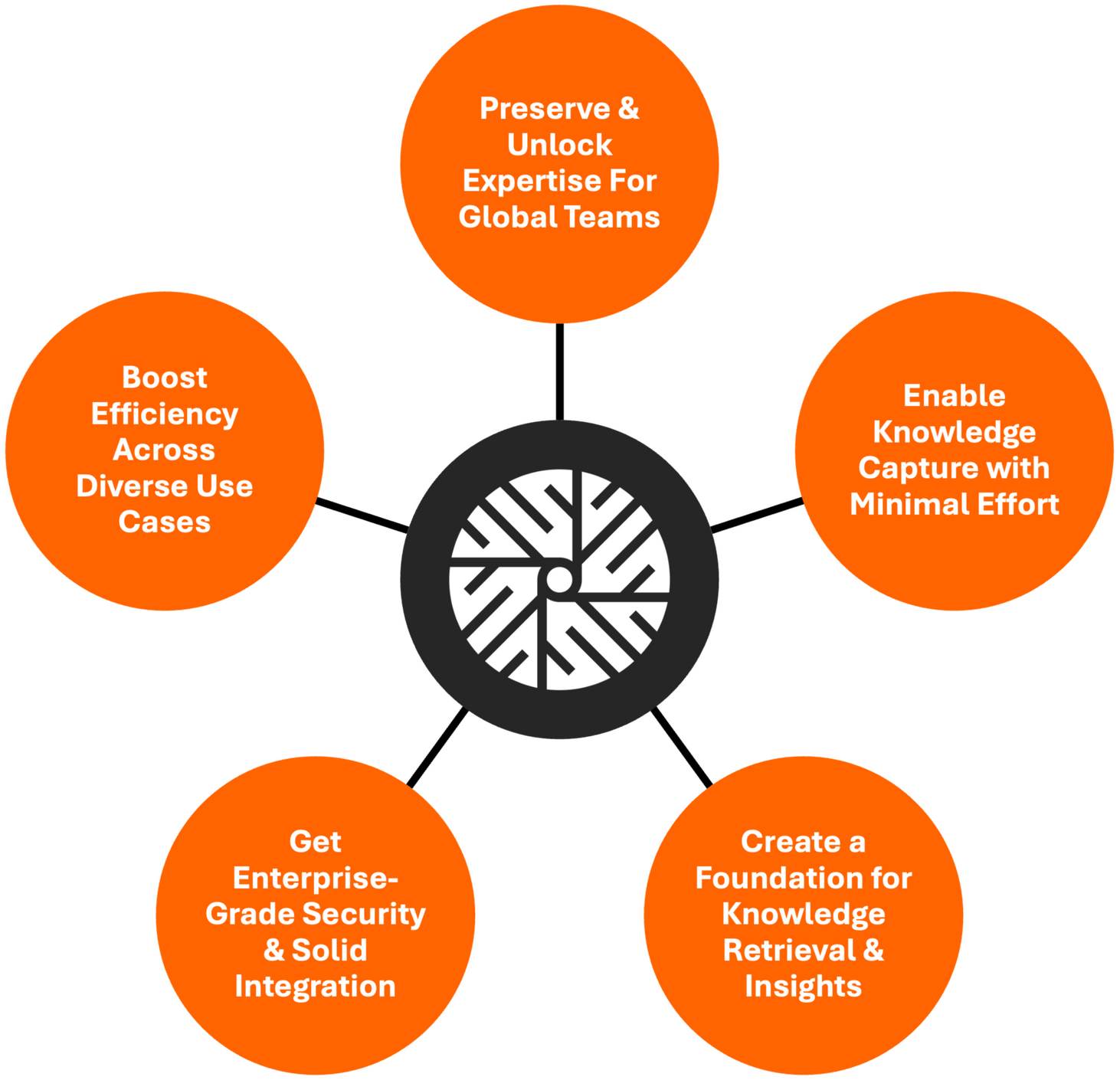
CogniCache is not another note-taking or knowledge-base tool.
It is your specialized knowledge extraction system.
You talk or write — CogniCache creates the documentation. No blank pages, no manual wiki writing.
It captures the knowledge that usually stays in people’s heads. Guided interviews surface context, decision logic, and company-specific know-how.
You get structured, reusable knowledge — not raw transcripts. Outputs are ready to review, share, export, and use in existing systems.
Quality stays under your control. CogniCache flags gaps, asks targeted follow-ups, and keeps the final result reviewable and traceable.
Your knowledge keeps getting more valuable. CogniCache surfaces insights, highlights what to capture next, and helps improve workflows over time.
Does your company forget? CogniCache helps you remember.
AI knowledge capture for modern organizations: Capture expert knowledge through AI-guided interviews and turn it into structured, reusable content for better knowledge transfer, stronger onboarding and offboarding, and more reliable internal AI.
Validate CogniCache Before you Commit
For companies with specific workflows and needs, we start with our Pilot Fit & Demo Session.
*30 minutes with the CEO to identify your highest-risk knowledge-loss use case, get a short demo and clarify the pilot approach. 100% no commitment. No newsletter signup.
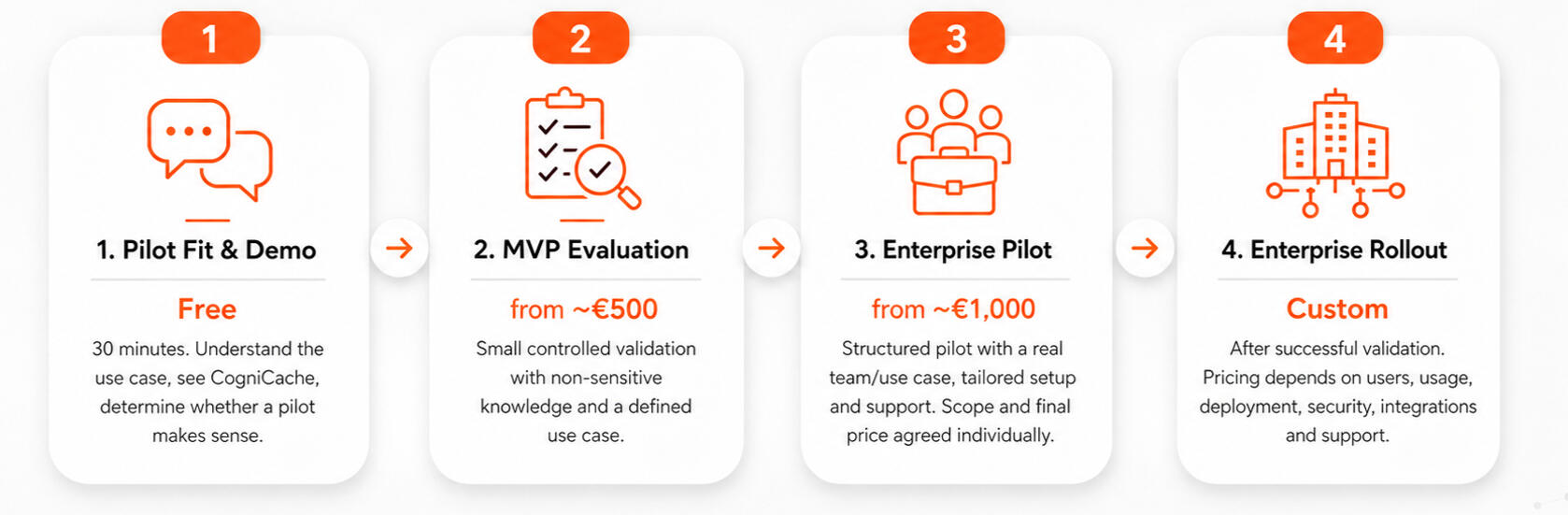
Not ready to commit yet?
Join our limited Founders Club for updates and early access.
Learn more about our 3-step Pilot in the 1-minute explainer video.
Step 1: Pilot Fit & Demo with experts
Step 2: MVP test with non-sensitive data
Step 3: Enterprise pilot with business data
One saved hour per week already covers the cost of CogniCache.
And this doesn’t even include the value of retaining critical know-how which is often far more costly than saved time.
1 hour saved per team/week due to knowledge capture
€50 – €100 internal cost per hour
→ €200–€400 saved per month
More questions about CogniCache? Read our FAQs or contact us below.

Thanks for Visiting!
Share CogniCache
Feedback From Our Early Access Partners

Stopped the Brain Drain
"We used to lose decades of critical workflow knowledge every time a senior expert retired. CogniCache is the first solution that actually captures important nuances in hours, not days, without burdening the team too much."
Peter - Operations Manager, Manufacturing Firm

Documentation That Gets Done
"Nobody on my team likes writing reports, so our wiki was always empty. Because CogniCache uses interviews, the team actually participates. It cuts our project handover time in half."
Sabrina - Senior Product Analyst, FinTech Scale-Up

Finally, Clean Data for our AI
"We already have terabytes of unstructured data that our internal AI can't use. CogniCache enables us the structured, machine-readable outputs we needed to finally make our RAG systems effective."
Nick - Solution Architect, Enterprise IT Services Firm

Turn Tacit Know-How into Assets
"We realized that 40% of our company's IP was walking out the door every evening. This tool turns that fleeting know-how into a permanent, searchable asset. It’s no longer optional for us."
Olivia - CEO, Mid-Sized Software House
Already convinced? Discover our Plans and get started now.
Only creators and admins need a license.
Starter
Try CogniCache risk-free
Free for 1 Creator
3 Interviews/Month
Chat Mode; 3 Templates; View & Edit Results; Export & Share
Standard
For individual creators
€19 per Creator/Month
50 Interviews/Month
Starter + Voice Mode; Unlimited Custom and Pre-existing Templates
Premium
For teams & admins
€39 per Creator/Month
Unlimited Interviews (fair use)
Standard + Team Motivation & Analytics; Personalized Suggestions; Admin Control
Enterprise
For organizations
Starts at €500/Month
Custom Interviews
Premium + SSO/SAML, Logs, SLA & Support, Self-Hosting, Integrations
Which CogniCache plan is right for me? Choose Starter if you want to explore CogniCache risk-free as an individual. Standard is ideal for individual creators who capture knowledge regularly and need more interviews and templates. Premium is designed for teams and admins who want unlimited interviews, team motivation, analytics, and control. Enterprise fits organizations with advanced security, compliance, and integration requirements.
What’s the difference between Standard and Premium? Standard focuses on individual productivity, offering more interviews, voice mode, and unlimited templates for a single creator. Premium adds team and admin capabilities—including unlimited interviews (fair use), analytics, motivation features, personalized suggestions, and admin control—making it suitable for structured, organization-wide knowledge capture.
How does pricing work per admin & creator? Pricing is based on the number of active Knowledge Admins & Creators—the people responsible for organizing and managing as well as capturing and structuring knowledge. Subject-matter experts who contribute their expertise during interviews do not require a separate account and license.
What does “unlimited interviews (fair use)” mean? Premium plans allow teams to capture knowledge without a fixed interview limit, as long as usage aligns with typical team workflows. This ensures flexibility for active teams while keeping the platform fair and sustainable for all customers.
What is the 6-week pilot and when should we use it? The 6-week pilot is ideal if you want to validate CogniCache in a real team setting before a full rollout. Starting at $1000, it includes a guided setup, tailored templates, and hands-on support to capture real knowledge, measure adoption, and demonstrate value—so you can make an informed decision with confidence.
Can we move from a pilot or lower plan to Enterprise later? Yes. Many teams start with a pilot or Premium plan and scale to Enterprise once governance, security, or organization-wide deployment becomes relevant. Upgrading is straightforward, and your captured knowledge remains fully reusable.
Our Insights
In an era where expertise is your most valuable asset, the biggest risk is silence.
Our insights bridge the gap between human intuition and digital systems, offering deep dives into AI-led knowledge capture, risk mitigation during offboarding, and the architecture of reliable RAG systems.
Here, we transform the conversations from our social channels into a structured roadmap for leaders who want to turn "walking expertise" into a permanent, AI-ready enterprise legacy.
Insight 1: The "Quiet Hero" Risk
Is Your Company’s Brain Walking Out the Door? Solving Single-Human Dependency.
The Insight:
The most dangerous system in any organization is the one only one person understands. While most documentation covers the "what," it fails to capture the decision logic, edge cases, and context that live only in your experts' heads.Key Takeaways for Decision Makers:
The Risk: Single-human dependency leads to rework, operational delays, and repeated mistakes when experts leave or change roles.
The Solution: Transition from "storing facts" to structured knowledge transfer.
The Focus: Effective offboarding requires capturing tacit expertise—turning individual wisdom into a searchable, digital corporate memory.
Insight 2: The Economic Impact of Knowledge Leaks
The $47M Annual Leak: Why Undocumented Expertise is an Operational Financial Drain.
The Insight:
Knowledge loss isn’t a sudden event; it’s a daily "slow leak." Data shows that 80% of critical institutional knowledge is undocumented, leading to massive productivity losses in large enterprises.Why it matters for Enterprise AI:
The "Slow Leak": Inefficiency shows up as slower onboarding and fragile RAG systems built on incomplete data.
Scalable Value: Experience-based knowledge must be captured in a structured, AI-ready format to prevent the "silent drain."
The Outcome: Turn unstructured expertise into a measurable data asset that fuels internal innovation and reduces departure risk.
Insight 3: The Future of Knowledge Management
Stop Your AI From Hallucinating: Building "AI-Ready" Knowledge Assets.
The Insight:
Most AI initiatives and internal Copilots fail quietly because they are grounded in messy, unstructured data. Modern Knowledge Management is no longer about simple storage—it’s about turning expert know-how into structured assets that LLMs can actually use.Strategic Advantage:
Beyond Documentation: The real bottleneck isn't a lack of tools; it's the gap between human expertise and machine-readable data.
AI Reliability: High-performing internal AI tools require a foundation of captured, experience-based knowledge to provide reliable answers.
Future-Proofing: By using AI-guided interviews to extract tacit knowledge, organizations create a living memory that scales with their technology.
Insight 4: The Hidden Bottleneck of Knowledge Management
Stop Asking People to “Document More.” Start Making Knowledge Easier to Capture.
The Insight:
Documentation rarely fails because employees do not care about sharing knowledge. It fails because the process is too high-friction. When capturing expertise requires writing long documents or updating complex systems, it simply does not happen consistently. The most valuable insights—why decisions were made, what nearly went wrong, or what should be done differently next time—remain trapped in conversations and in people’s heads.Modern Knowledge Management therefore requires a shift: instead of asking experts to write more documentation, organizations must make it easier to extract tacit knowledge through structured conversations and guided prompts.Strategic Advantage:
Friction Reduction: When knowledge capture becomes faster and more guided, experts are far more likely to share their experience. Structured interviews replace the blank page with targeted questions that draw out the “how,” “why,” and “what-if” behind real decisions.
Better Knowledge, Not Just More Documentation: The goal is not to collect more text. It is to capture deeper context—decisions, trade-offs, and lessons learned—that traditional documentation often misses.
Faster Onboarding and Less Dependency on Experts: One of the clearest indicators of healthy knowledge management is onboarding speed. When knowledge is structured and accessible, new hires can become productive without constantly interrupting senior staff.
Institutional Memory That Survives Turnover: By reducing friction in knowledge capture and using structured templates, organizations create reusable knowledge assets that persist beyond individuals—protecting critical expertise from being lost when employees move on.
Insight 5: Knowledge Has a Half-Life
Captured Knowledge Is Not Finished Knowledge: Why Organizational Memory Must Stay Current.
The Insight:
Capturing expertise once is not enough. Processes change, customer requirements evolve, exceptions become standard practice, and yesterday’s best practice can quietly become outdated. In some environments, stale knowledge is not merely inefficient. It can become a genuine operational, compliance, or safety risk if employees or AI systems continue following obsolete guidance.Strategic Advantage:
Continuous Validation: Knowledge should be reviewed, refreshed, and enriched as work evolves.
Trustworthy Knowledge Base: Employees need to know that the guidance they find reflects how the organization operates today.
Safer AI: Internal AI and RAG systems become more reliable when their underlying knowledge is current and validated, rather than simply extensive.
Living Organizational Memory: Effective knowledge management is a continuous learning cycle, not a one-time documentation project.
Insight 6: Accelerating the Junior-to-Senior Learning Curve
You Cannot Give Someone 15 Years of Experience. But You Can Give Them Access to What Those 15 Years Taught.
The Insight:
Seniority is not simply accumulated information. It is judgment, pattern recognition, exceptions, shortcuts, warning signs, and knowing why one approach works better than another. Most onboarding transfers tasks and procedures, but very little of this deeper reasoning.Structured knowledge capture allows organizations to systematically transfer more of that experience to less experienced employees.Strategic Advantage:
Capture Judgment, Not Just Instructions: Preserve how experienced employees evaluate situations and make decisions.
Faster Capability Building: Juniors start with access to lessons that otherwise take years of trial and error to discover.
Reduce Expert Dependency: Senior employees spend less time repeatedly answering the same contextual questions.
Preserve Experience at Scale: Individual expertise becomes reusable organizational knowledge rather than remaining locked within a few people.
Please sign up to get access. Thanks.
The 20% Productivity Gap: Discover exactly how knowledge inefficiencies are costing you roughly 20% of your team's total productivity.
The "Unique Knowledge" Risk: 42% of critical expertise is locked in the heads of individual employees.
The AI Missing Link: Why your RAG systems and chatbots will fail without structured tacit knowledge.
Or listen to a 20-minute summary of the report right here.
CogniCache is currently in Early Access.
Join the Founders Club to stay updated and get access first.

Not ready yet?
What would you need to feel confident signing up?
20 seconds. No email required.
CogniCache is currently in Early Access.
Join the Founders Club to stay updated and get access first.

Not ready yet?
What would you need to feel confident signing up?
20 seconds. No email required.
Share CogniCache
CogniCache is currently in Early Access.
Join the Founder’s Club to stay updated and get access first.
Early access members receive 30% off for the first 6 months after launch.

Not ready yet?
What would you need to feel confident signing up?
20 seconds. No email required.
Share CogniCache
CogniCache is currently in Early Access.
Join the Founder’s Club to stay updated and get access first.
Early access members receive 30% off for the first 6 months after launch.

Not ready yet?
What would you need to feel confident signing up?
20 seconds. No email required.
Share CogniCache
Enterprise-Ready Knowledge Capture built for Security and Control.
Enterprise plans typically start at €500/Month
(Final pricing depends on scope and requirements)

CogniCache is currently in Early Access.
We are working closely with organizations that have advanced security, compliance, or deployment needs:
SSO / SAML and role-based access control
Audit logs and compliance-friendly exports
Data residency options and self-hosting
SLA and priority support
Custom workflows and integrations
Contact us below to start a conversation.
Not ready yet?
What would you need to feel confident about CogniCache?
20 seconds. No email required.
Share CogniCache
Capture critical knowledge before it’s lost
CogniCache is an AI-powered knowledge transfer software for knowledge capture and preservation in organizations. Capture expert knowledge through guided interviews, structure it automatically, and use it for offboarding, onboarding, and internal AI.
*In a free, short session, we give a demo & clarify your use case, key risks, and the right pilot path.
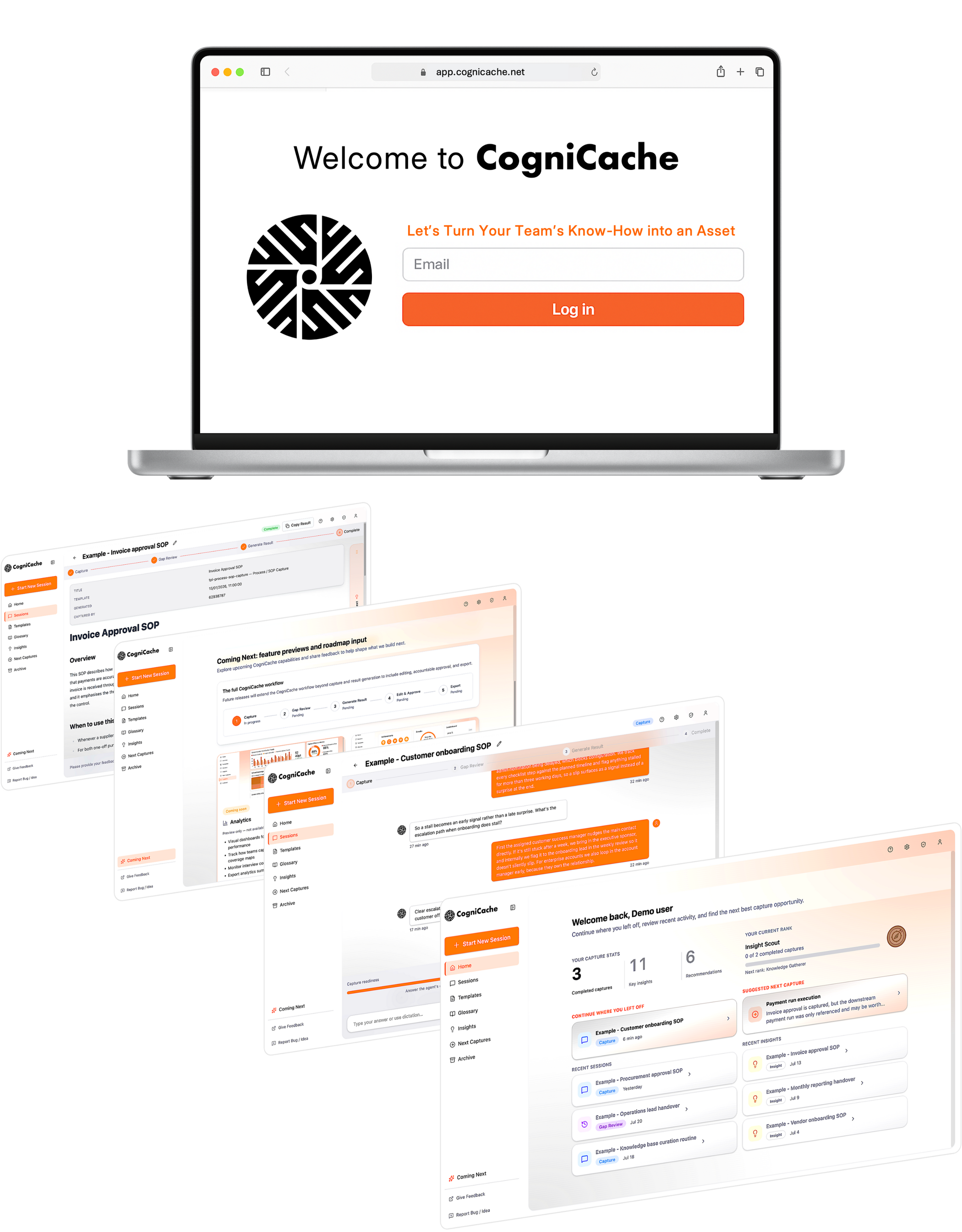
What is CogniCache? Founder Andy gives you the 80-second intro.

Compliant & Secure

Strategic & Efficient

User-Centric & Smart
Critical expertise is like gold dust: precious, yet easily lost. CogniCache extracts critical expertise and transforms it into structured data.
CogniCache helps you with these and many more use cases...
Knowledge Retention During Expert Offboarding
Knowledge Transfer Across Teams and Departments
Onboarding with Structured Expert Knowledge

Finally, Clean Data for our AI
"We already have terabytes of unstructured data that our internal AI can't use. CogniCache enables us the structured, machine-readable outputs we needed to finally make our RAG systems effective."
Nick - Solution Architect, Enterprise IT Services Firm

Turn Tacit Know-How into Assets
"We realized that 40% of our company's IP was walking out the door every evening. This tool turns that fleeting know-how into a permanent, searchable asset. It’s no longer optional for us."
Olivia - CEO, Mid-Sized Software House
What is CogniCache?
CogniCache is not just another wiki or documentation tool.
It is AI-powered knowledge transfer software and a knowledge capture tool that actively captures expert knowledge through guided interviews, automatically structures it, and turns it into reusable knowledge assets.
Without CogniCache
Knowledge is recorded, not actively extracted.
Meeting recordings and transcripts miss tacit knowledge, context, and decision logic.
ChatGPT, Claude and others are general-purpose assistants, not a specialized expert interviewer.
Follow-up questions are inconsistent and user-dependent.
Output stays fragmented or unstructured without clear insights.
Ownership, review, and traceability are often unclear.
With CogniCache
Know-how is actively captured through a guided workflow.
Tacit knowledge, context, and decision logic are surfaced systematically.
CogniCache acts as a specialized AI expert interviewer and guides through the workflow.
Targeted follow-up questions uncover what generic tools miss.
Output becomes structured, reusable knowledge assets.
Capture, review, and responsibility are clearly documented.
CogniCache can be used as a standalone solution or in combination with existing knowledge systems such as Confluence, Google Workspace, Notion, or SharePoint.
How CogniCache captures Expert Knowledge
1. Plan Interview
Select an existing template or start from scratch by defining your topics and participants.
CogniCache generates a structured, tailored interview guide based on your organization’s domain, terminology, and established approaches, as well as your role.
You can review, adjust, and refine everything easily.

2. Conduct Interview
Engage in a single or group interview guided by an intuitive AI assistant— through voice or chat. Unlike simple transcribers, CogniCache’s AI doesn’t just record; it asks smart follow-up questions, explores topics from multiple angles, reasons over responses, and structures the output into clear, usable insights.
3. Receive Results
CogniCache transcribes, summarizes, and structures your captured knowledge into clear, organized documents. You can review and adjust to ensure correctness and completeness. Once finished integrate the output into your existing knowledge bases.

Watch the 2-minute teaser.
Test CogniCache
For companies with specific workflows and needs, we clarify in a Pilot Fit & Demo Session:
your most critical knowledge-loss use case
whether an MVP test with non-sensitive data makes sense
whether an enterprise pilot with approval or deployment in your own infrastructure is the right path
*In a free 30-minute session with the CEO, determine whether CogniCache fits your use case and get a demo. 100% non-binding. No newsletter sign-up.
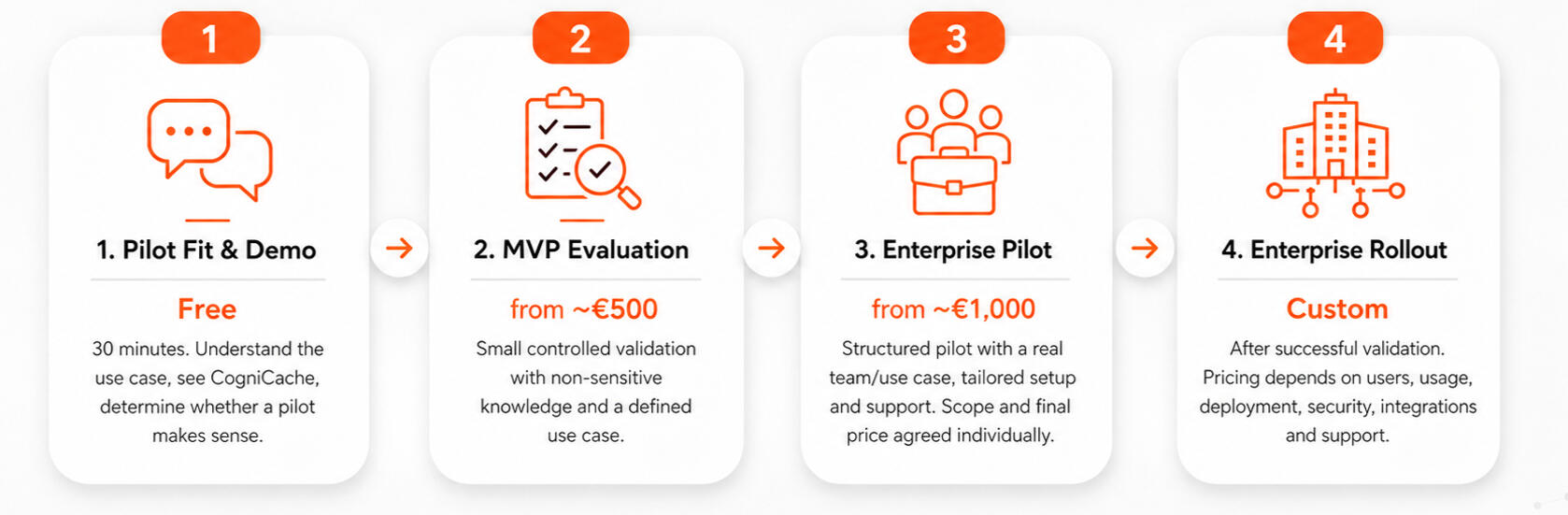
Learn more about our 3-step Pilot in the 1-minute explainer video.
Step 1: Pilot Fit & Demo with experts
Step 2: MVP test with non-sensitive data
Step 3: Enterprise pilot with business data
You may have asked yourself these questions too
Can CogniCache be used with real enterprise knowledge? Yes — after internal company approval and within the right pilot setup.
Does everything have to run in your cloud? No — deployment in your own infrastructure is also possible.
How does a pilot start? It starts with a pilot fit & demo session, then proceeds based on your use case.
Alternatively, feel free to contact us if you have any questions.

Kritisches Expertenwissen sichern, bevor es verloren geht.
CogniCache ist eine KI-basierte Software für Wissenstransfer, Wissenserfassung und Wissenssicherung im Unternehmen. Erfassen Sie Expertenwissen per geführtem Interview, strukturieren Sie es automatisch und nutzen Sie es für Offboarding, Onboarding und interne KI.
*In einer kostenfreien, kurzen Session prüfen wir gemeinsam Use Case, Risiken und den Pilotpfad, inklusive kurzer Demo.
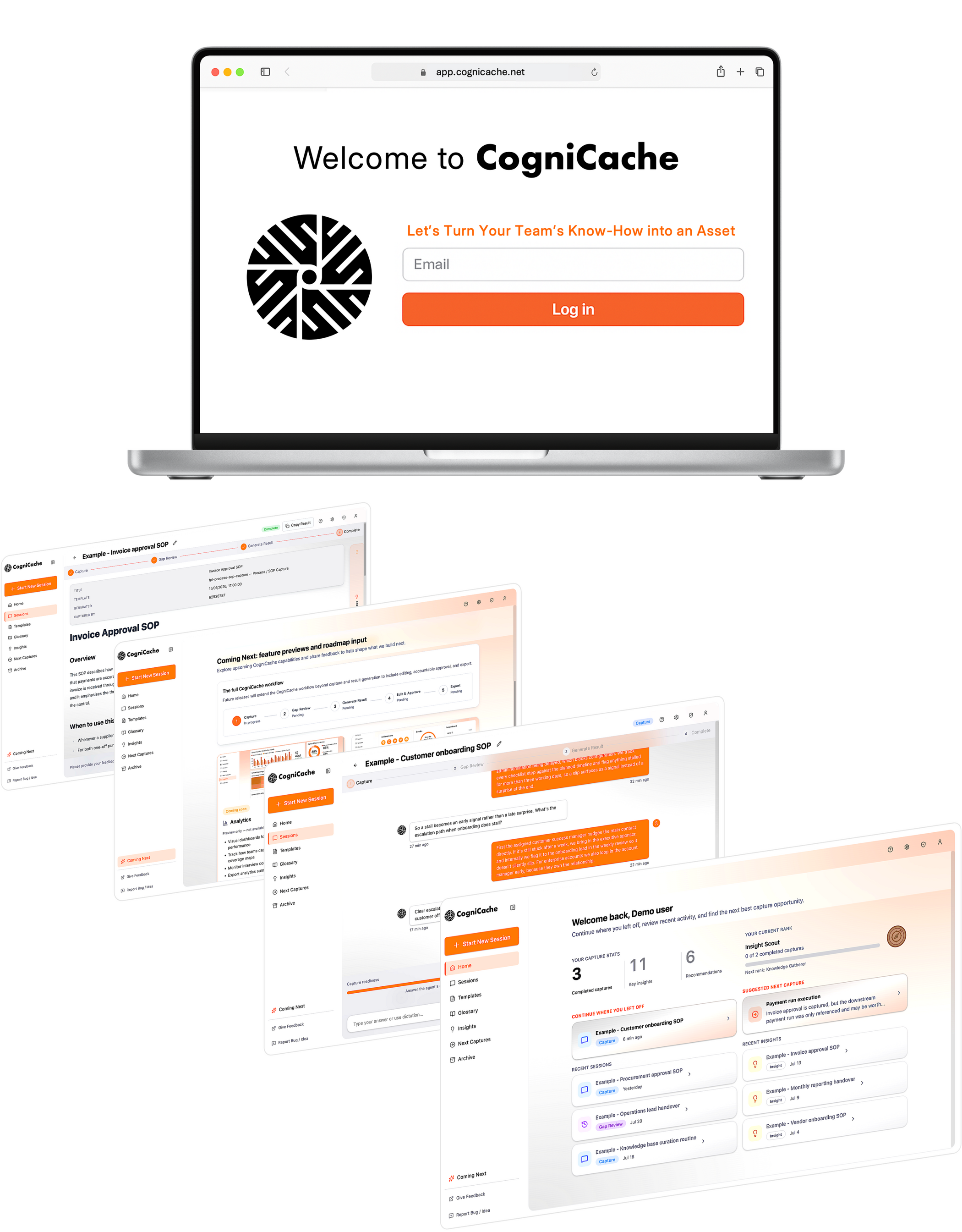
Was ist CogniCache?
Gründer Andreas erklärt es in 90 Sekunden.

Konform & Sicher

Strategisch & Effizient

Nutzerzentriert & Smart
Kritisches Expertenwissen ist wie Goldstaub: wertvoll, aber leicht verloren. CogniCache extrahiert kritisches Expertenwissen und wandelt es in strukturierte Daten um.
CogniCache hilft bei diesen und vielen weiteren Anwendungsfällen
Wissenssicherung bei Offboarding
Wissenstransfer zwischen Teams
Schnelleres Onboarding mit strukturiertem Wissen

Wissensabfluss gestoppt
„Früher haben wir bei Renteneintritt eines erfahrenen Experten Jahrzehnte an entscheidendem Prozesswissen verloren. CogniCache ist die erste Lösung, die Feinheiten in Stunden statt Tagen für unsere Prozessdokumentation erfasst – ohne das Team dabei übermäßig zu belasten.“
Peter – Betriebsleiter, Fertigungsunternehmen

Dokumentation, die erledigt wird
„In meinem Team schreibt niemand gerne Berichte, weshalb unser Wiki immer leer blieb und Wissenstransfer schwierig war. Da CogniCache auf Interviews setzt, macht das Team jetzt tatsächlich mit. Unsere Zeit für Projektübergaben hat sich dadurch halbiert.“
Sabrina - Senior Product Analyst, FinTech Scale-Up
Was ist CogniCache?
CogniCache ist keine weitere Wiki- oder Dokumentationslösung.
Es ist eine KI-basierte Software für Wissenstransfer und Wissenserfassung, die Expertenwissen durch geführte Interviews aktiv erfasst, automatisch strukturiert und als wiederverwendbare Wissensbausteine bereitstellt.
Ohne CogniCache
Wissen wird dokumentiert, aber nicht systematisch extrahiert
Meetingaufnahmen und Transkripte erfassen Kontext und Entscheidungslogik nur unvollständig
ChatGPT, Claude und Co sind allgemeine Assistenten, keine spezialisierter Experten-Interviewer
Ergebnisse bleiben oft unstrukturiert und schwer wiederverwendbar
Verantwortung, Review und Nachvollziehbarkeit sind oft unklar
Mit CogniCache
Wissen wird aktiv durch einen geführten Workflow erfasst
Implizites Wissen, Kontext und Entscheidungslogik werden systematisch sichtbar
CogniCache agiert als spezialisierter KI-Experten-Interviewer und führt durch den Workflow
Ergebnisse werden zu strukturierten, wiederverwendbaren Wissensbausteinen
Erfassung, Prüfung und Verantwortlichkeiten sind klar dokumentiert
CogniCache kann eigenständig genutzt oder in bestehende Wissenssysteme integriert werden – z. B. Confluence, Google Workspace, Notion oder SharePoint.
So erfasst CogniCache Wissen
1. Interview planen
Wählen Sie eine Vorlage oder starten Sie mit eigenen Themen und Teilnehmenden. CogniCache erstellt daraus einen strukturierten, auf Fachbereich, Terminologie und Rolle abgestimmten Interviewleitfaden. Anschließend können Sie alles einfach prüfen und anpassen.

2. Interview durchführen
Führen Sie ein Einzel- oder Gruppeninterview per Sprache oder Chat – begleitet von einem intuitiven KI-Assistenten. Anders als einfache Transkriptionstools zeichnet CogniCache nicht nur auf: Die KI stellt gezielte Rückfragen, beleuchtet Themen aus mehreren Perspektiven und überführt Antworten in klare, nutzbare Erkenntnisse.
3. Ergebnisse erhalten
CogniCache transkribiert, strukturiert und verdichtet erfasstes Wissen zu klaren, geordneten Dokumenten. Sie können die Ergebnisse prüfen und anpassen, um Vollständigkeit und Richtigkeit sicherzustellen.
Anschließend integrieren Sie die Inhalte in Ihre bestehenden Wissenssysteme.

Sehen Sie sich den 2-minütigen Teaser an.
CogniCache zuerst testen
Für Unternehmen mit spezifischen Workflows & Anforderungen klären wir in einer Pilot-Fit- & Demo-Session:
Ihren kritischsten Wissensverlust-Use-Case
ob ein MVP-Test mit unkritischen Daten sinnvoll ist
ob ein Enterprise-Pilot mit Freigabe oder Deployment in Ihrer Infrastruktur der richtige Weg ist
*Prüfen Sie kostenfrei in 30 Minuten mit dem CEO, ob CogniCache zu Ihrem Use Case passt, inklusive kurzer Demo. 100 % unverbindlich. Kein Newsletter-Signup.
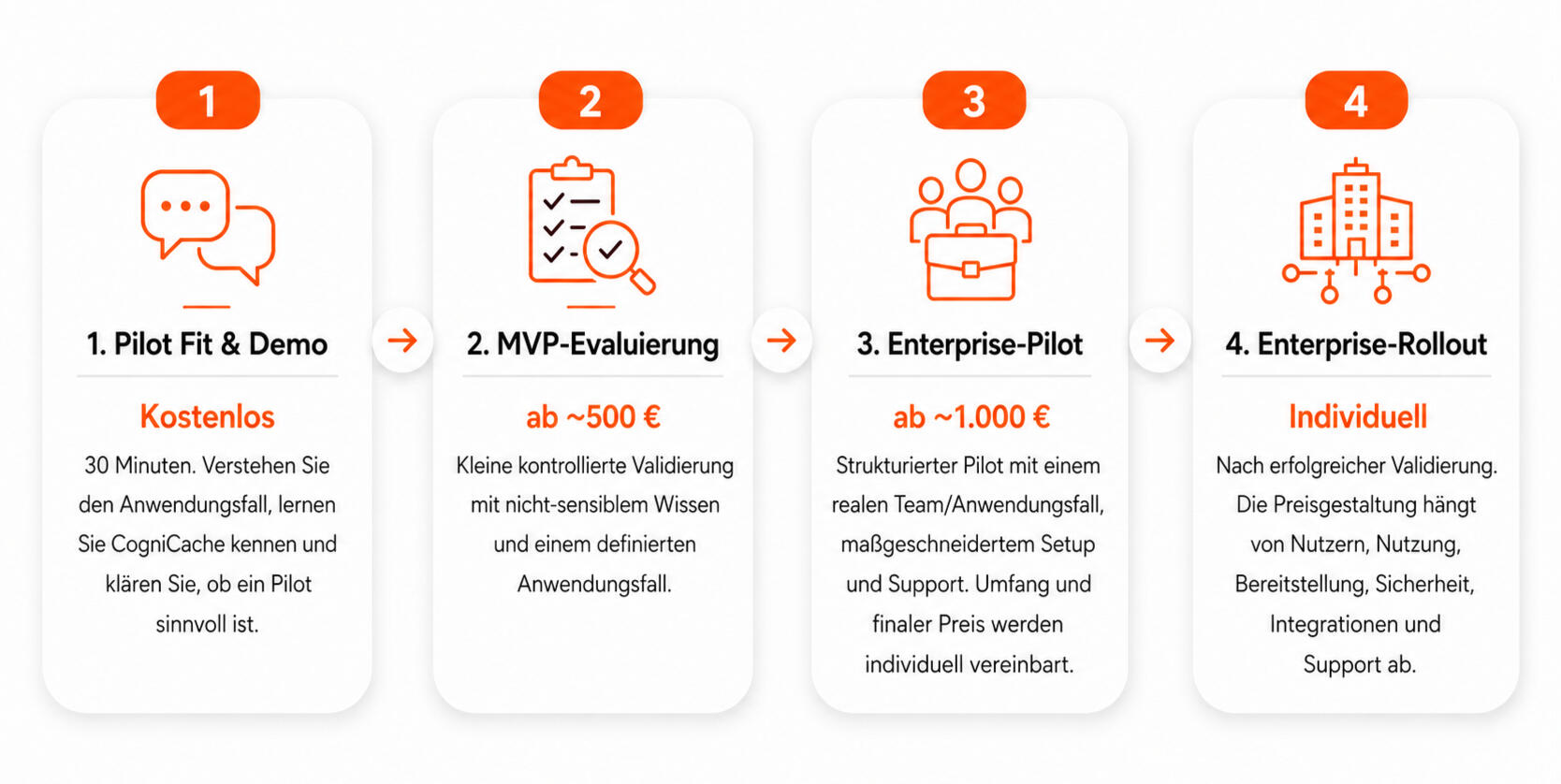
Erfahren Sie mehr über unseren 3-stufigen Pilotprozess im 1-minütigen Erklärvideo.
Vielleicht haben Sie sich auch diese Fragen gestellt
Kann CogniCache mit echtem Unternehmenswissen genutzt werden? Ja, nach interner Freigabe des Unternehmens im passenden Pilot-Setup.
Muss alles in Ihrer Cloud laufen? Nein, alternativ ist auch ein Deployment in der eigenen Infrastruktur möglich.
Wie startet ein Pilot? Zunächst mit einer Pilot-Fit- & Demo-Session, danach abhängig vom Use Case.
Alternativ kontaktieren Sie uns gerne bei Fragen.

Explore the Workflow for an Exemplary Single Interview
Step 1: You define the interview guide supported by the CogniCache Assistant (demo topic: "Preserving Critical Knowledge in Engineering Projects")
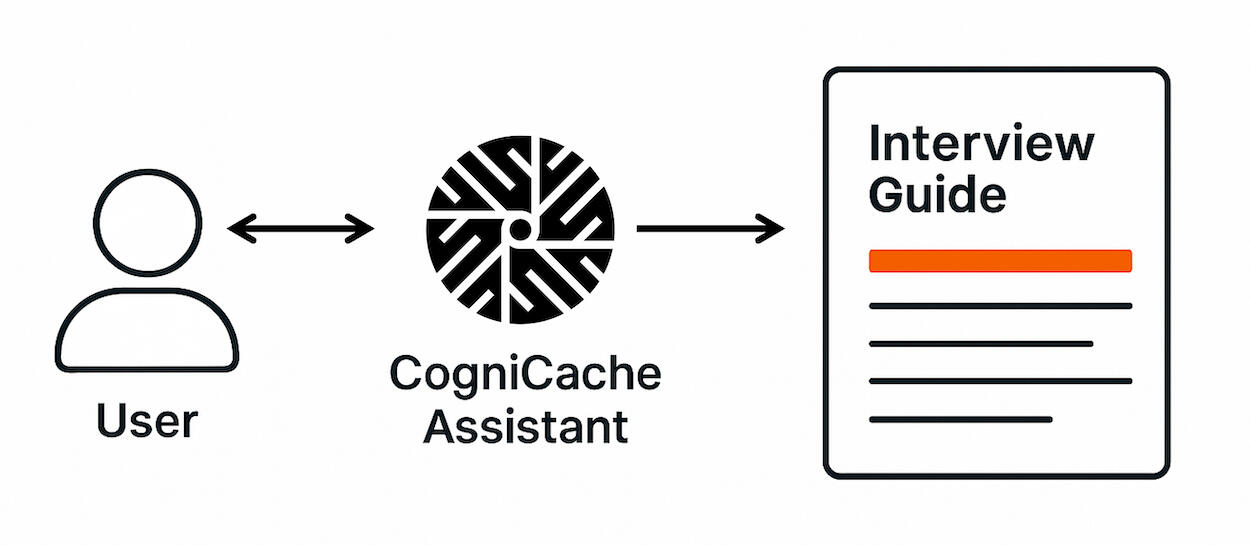
Result 1: Interview Guide
Topic: Preserving Critical Knowledge in Engineering ProjectsIntro
This interview explores how your team handles the documentation, transfer, and reuse of project-related expertise — particularly the tacit knowledge that often goes undocumented but is critical to operational success.Chapter 1: Context & Knowledge Flow
Goal: Understand how knowledge flows in typical projects
Questions:
- Can you briefly describe your role and how it connects to engineering projects?
- In a typical project, where is most of the knowledge captured and stored?
- How do team members usually access project-related insights?Chapter 2: Capturing Tacit Knowledge
Goal: Identify current practices and gaps
Questions:
- When valuable lessons are learned during a project, how are they documented?
- How do you capture knowledge that exists mostly in people’s heads?
- Are there any people on your team who are “go-to experts,” and how is their expertise shared?Chapter 3: Challenges & Risks
Goal: Explore barriers to effective knowledge capture
Questions:
- Have you ever experienced knowledge loss when someone left the team?
- What’s the biggest obstacle to getting people to document what they know?
- Are there any organizational or technical barriers that prevent knowledge sharing?Chapter 4: Learnings & Best Practices
Goal: Uncover strategies that work
Questions:
- What has worked well in your organization for knowledge sharing?
- Can you share an example of when well-documented knowledge saved the day?
- If you could design your ideal knowledge capture tool, what would it do?
Step 2: You conduct the conversational interview either using a chat interface or voice mode based on the defined interview guide.
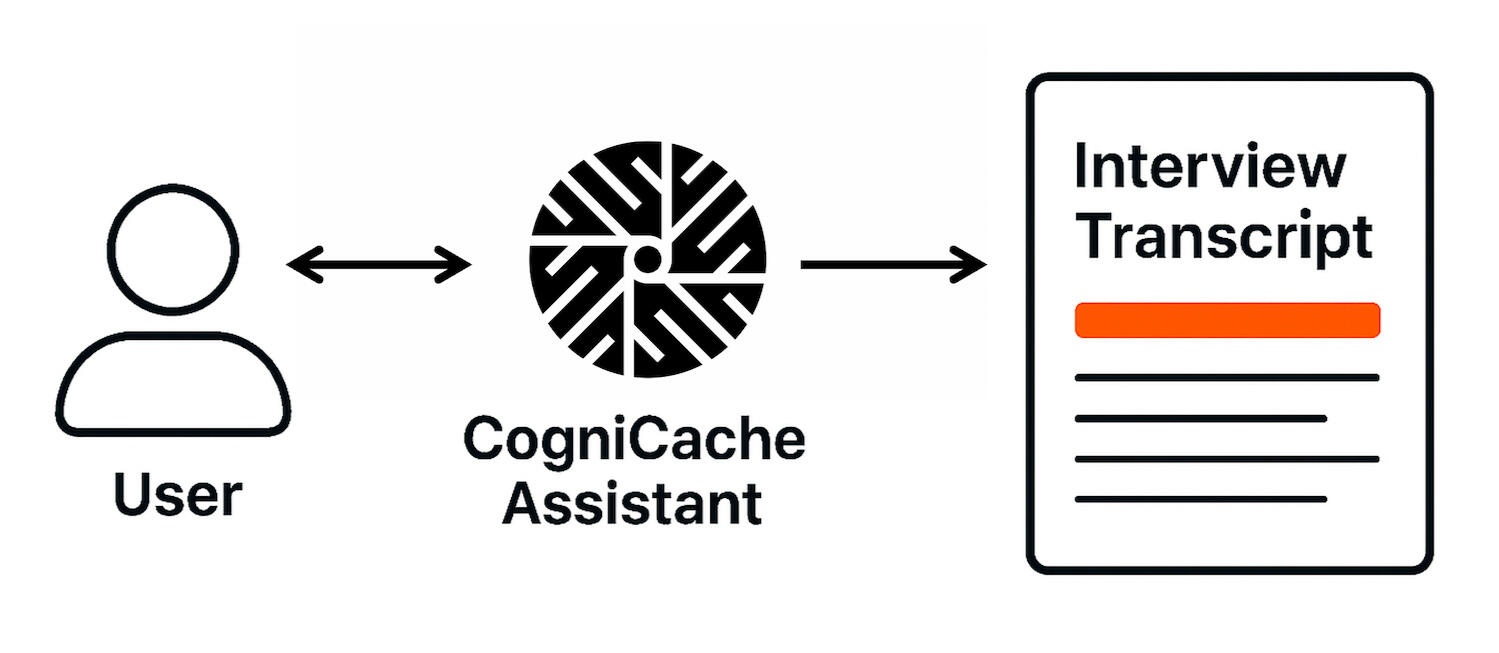
Listen to the recording of the interview conducted with CogniCache using Voice Mode:
Result 2: Clean Interview Transcript
Intro & Chapter 1: Context & Knowledge Flow🤖 CogniCache Assistant: Hi! Great to meet you. Let’s dive into how your team captures and shares knowledge. To get started, could you briefly describe your role and how it connects to engineering projects?
🧑🏽 User: I’m a project engineer overseeing cross-functional teams for product launches. I manage workflows and ensure technical consistency across all deliverables.🤖 CogniCache Assistant: Got it—so you’re deeply involved across different touchpoints. In that context, where does most of your team’s knowledge typically get captured or stored?
🧑🏽 User: Mostly in email threads, PowerPoint presentations, and SharePoint folders. Some teams use OneNote for task-specific notes.🤖 CogniCache Assistant: Thanks! That sounds like a mix of informal and semi-structured sources. Would you say these are easy for others to find and navigate later?
🧑🏽 User: Not really. Most people just ask around or dig through folders. There’s no central place for lessons learned or knowledge.🤖 CogniCache Assistant: So it’s more person-dependent than system-driven. That can create gaps when people move on or aren’t available, right?🧑🏽 User: Exactly. It really slows us down sometimes.⸻Chapter 2: Capturing Tacit Knowledge🤖 CogniCache Assistant: Let’s talk about the know-how that often stays in people’s heads. When valuable lessons are learned mid-project, how are they usually documented—if at all?
🧑🏽 User: Honestly, they’re rarely written down. Maybe someone adds a slide or two to a presentation, but that’s about it.🤖 CogniCache Assistant: That’s common. Would it help if there were a lightweight, structured way to capture that info during or right after the work is done?
🧑🏽 User: Absolutely. Right now, it’s just not part of the process.🤖 CogniCache Assistant: And during handovers—especially in cross-functional teams—how do you capture what’s in people’s heads before they roll off?
🧑🏽 User: We try to do a knowledge transfer meeting, but it’s usually rushed. There’s no structure, so important things get missed.🤖 CogniCache Assistant: That can be risky. Do you have any go-to experts whose knowledge others rely on?
🧑🏽 User: Yes, for sure. For example, we have a couple of people who really understand our test automation stack. People go to them all the time.🤖 CogniCache Assistant: Are their methods or decisions documented anywhere?
🧑🏽 User: Not really. It’s mostly in their heads—or you need to ping them directly.⸻Chapter 3: Challenges & Risks🤖 CogniCache Assistant: Has your team experienced the impact of knowledge walking out the door?
🧑🏽 User: Definitely. Our lead electrical engineer left last year, and we had to reverse-engineer a bunch of his work. It cost us weeks.🤖 CogniCache Assistant: That must’ve been frustrating. What was the biggest challenge in trying to recover that knowledge?
🧑🏽 User: Time, mostly. People are busy. There was no detailed handover, and the tools we have aren’t user-friendly.🤖 CogniCache Assistant: So even if people want to document something, the effort feels too high?
🧑🏽 User: Exactly. No one enjoys doing it, and there’s no clear format or process anyway.🤖 CogniCache Assistant: Is there an expectation or incentive for knowledge sharing in your team?
🧑🏽 User: Not really. It’s more of a “nice to have.”⸻Chapter 4: Learnings & Best Practices🤖 CogniCache Assistant: Let’s switch gears—what has actually worked well in terms of knowledge sharing in your org?
🧑🏽 User: Brown bag sessions work surprisingly well. And we’ve started recording walkthroughs for onboarding.🤖 CogniCache Assistant: That’s great! Recorded walkthroughs can be really valuable. Has there been a moment where good documentation saved the day?
🧑🏽 User: Yes! Our test automation lead once created a decision tree to troubleshoot common system errors. It’s saved us countless hours.🤖 CogniCache Assistant: That’s exactly the kind of structured insight others could reuse. If you could design your ideal knowledge tool, what would it do differently?
🧑🏽 User: It would ask smart questions, organize everything clearly, and ideally feed straight into our existing systems.🤖 CogniCache Assistant: Thanks—that’s super helpful. That’s exactly the kind of support CogniCache aims to provide: smart interviews, structured output, and seamless integration.
Step 3: CogniCache structures the interview transcript, summarizes the text and extracts key insights and improvement options.
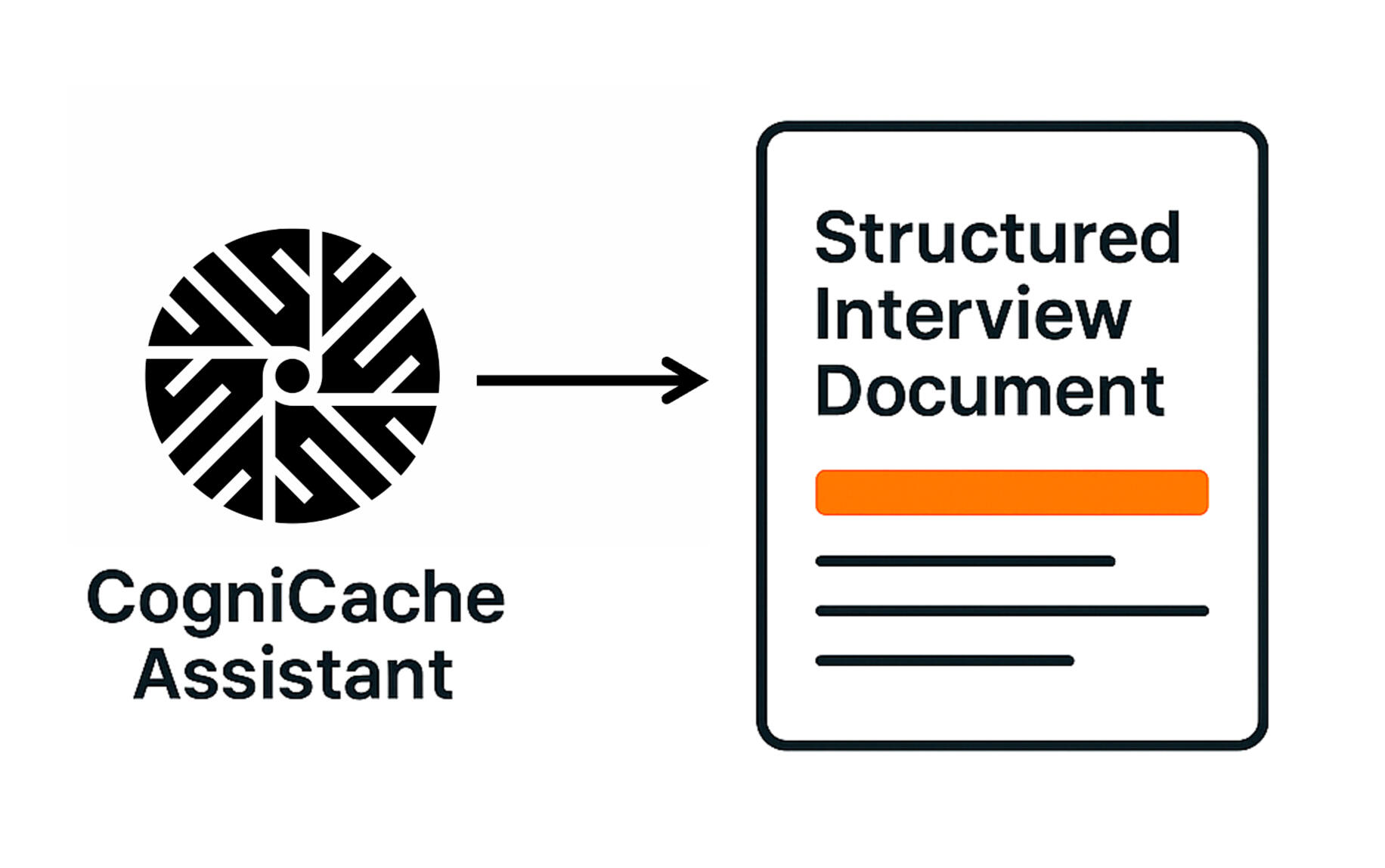
Result 3: Structured Interview Document
Preserving Critical Knowledge in Engineering Projects
Summary
This interview explores the challenges and current practices around knowledge capture in engineering projects. The respondent plays a central coordination role and reveals that most critical knowledge remains undocumented. Tools like email and SharePoint are used, but they lack structure and consistency. Tacit knowledge — especially from experts — is hard to extract and often lost during employee transitions. Opportunities exist for AI-powered tools like CogniCache to automate and simplify structured knowledge retention.Section 1: Context & Knowledge Flow
The user works as a project engineer overseeing cross-functional teams. While technical documentation exists in scattered formats (e.g., PowerPoint, OneNote), there is no single, structured repository for lessons learned or historical decisions. Access to past insights is informal and heavily reliant on person-to-person communication, leading to inefficiencies.Section 2: Capturing Tacit Knowledge
The current approach to capturing lessons learned is inconsistent and largely dependent on individual initiative. Tacit knowledge from experienced team members is rarely documented and typically accessed through verbal communication. This reliance on informal exchanges creates knowledge silos and bottlenecks.Section 3: Challenges & Risks
The organization has experienced clear cases of knowledge loss. When experienced team members leave, critical information disappears with them, leading to delays, rework, and loss of continuity. Time constraints, a lack of incentives, and unintuitive tooling were named as the top barriers to effective documentation.Section 4: Learnings & Best Practices
Despite the challenges, small-scale practices such as team-led learning sessions and pre-recorded walkthroughs have had a positive impact. One standout example is a decision tree created by a test automation lead, which significantly reduced support overhead. The ideal solution envisioned by the interviewee would automate the question flow, simplify structuring, and support seamless integration into their existing systems.Key Insights
Tacit knowledge remains undocumented and difficult to access across teams.
There is strong interest in AI-driven solutions that simplify capture and structuring.
Employee departure results in significant productivity loss due to missing expertise.
Teams lack the time and tools to proactively document what they know.
Even small efforts at structured documentation yield measurable impact.
Improvement Options
Introduce Structured Knowledge Capture at Project Milestones
• Why: Knowledge is currently scattered and informal.
• How: Integrate regular interviews after key phases (e.g. planning, testing, handover) to capture lessons, decisions, and context.
• Impact: Builds a consistent and searchable record over time.Implement Expert Knowledge Extraction Sessions
• Why: Tacit knowledge from senior engineers is undocumented and lost during turnover.
• How: Schedule guided interviews with domain experts (e.g., quarterly), focusing on unique procedures, decisions, and best practices.
• Impact: Reduces dependency on individuals and creates reusable training/reference assets.Embed Knowledge into Centralized Tool
• Why: Documentation is fragmented across emails, OneNote, SharePoint.
• How: Integrate outputs directly into a centralized knowledge platform like SharePoint libraries or Confluence pages.
• Impact: Ensures a centralized location for knowledge access.Create Lightweight Knowledge KPIs
• Why: Documentation is seen as extra work without clear value.
• How: Encourage teams to run at least one session per project phase, and track % of projects with documented insights.
• Impact: Drives behavior change without heavy process overhead.
Final Step: You can now edit, share or download the document and finally integrate it into your knowledge management system of choice.
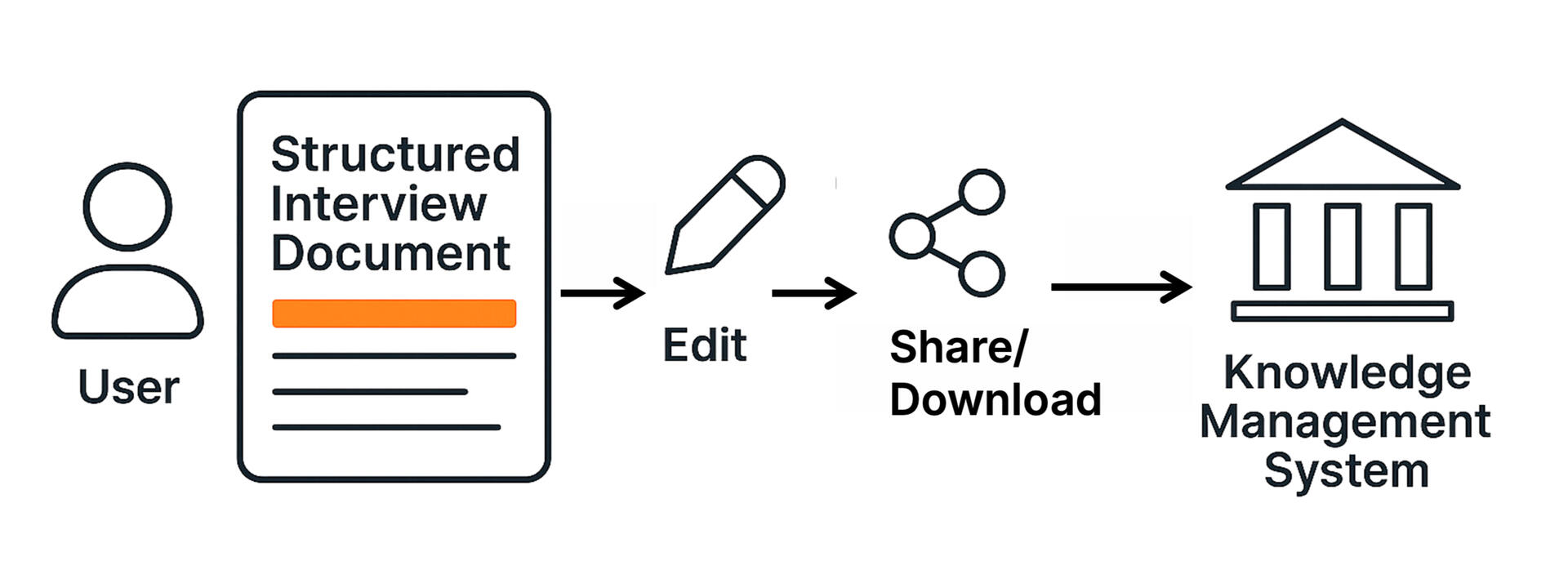
Explore 2 Stories that may sound familiar to you

Story 1: The Lost Wisdom of Thomas Jensen
For nearly two decades, Thomas Jensen had been the unsung hero of InnoTech Corp, quietly keeping their legacy ERP system running. He was known to all as the person to call when things went wrong, able to troubleshoot in minutes issues that left others scratching their heads for hours. But Thomas had never liked documentation. His genius lived entirely within his mind.
The day Thomas retired, the company threw him a celebration, said their thanks, and quickly moved on. They hired a bright, capable replacement named Lucas. Lucas, eager to prove himself, dove straight into the system and made what seemed a simple change—a minor database configuration adjustment. He didn't realize this tweak was precisely what Thomas had avoided for years, knowing the havoc it could unleash.
Within days, the ERP system began to falter. Inventory counts were suddenly incorrect, purchase orders stalled, and customer orders were delayed. The heart of InnoTech's operations slowed, then stopped. Panic ensued. Managers and IT scrambled to find documentation or insights left behind by Thomas—but found nothing. Hours turned into days, and still, the problem persisted.
With each passing day, losses mounted. Millions evaporated in delays, lost sales, and customer dissatisfaction. Consultants were hired, costing even more, but without Thomas's tacit knowledge, progress was slow and costly.
Finally, after weeks of chaos, Thomas was called back from retirement as a last resort. Within mere hours, the problem was fixed. But the damage was done. The company realized, painfully, that the knowledge they had relied on was now walking out the door for good.
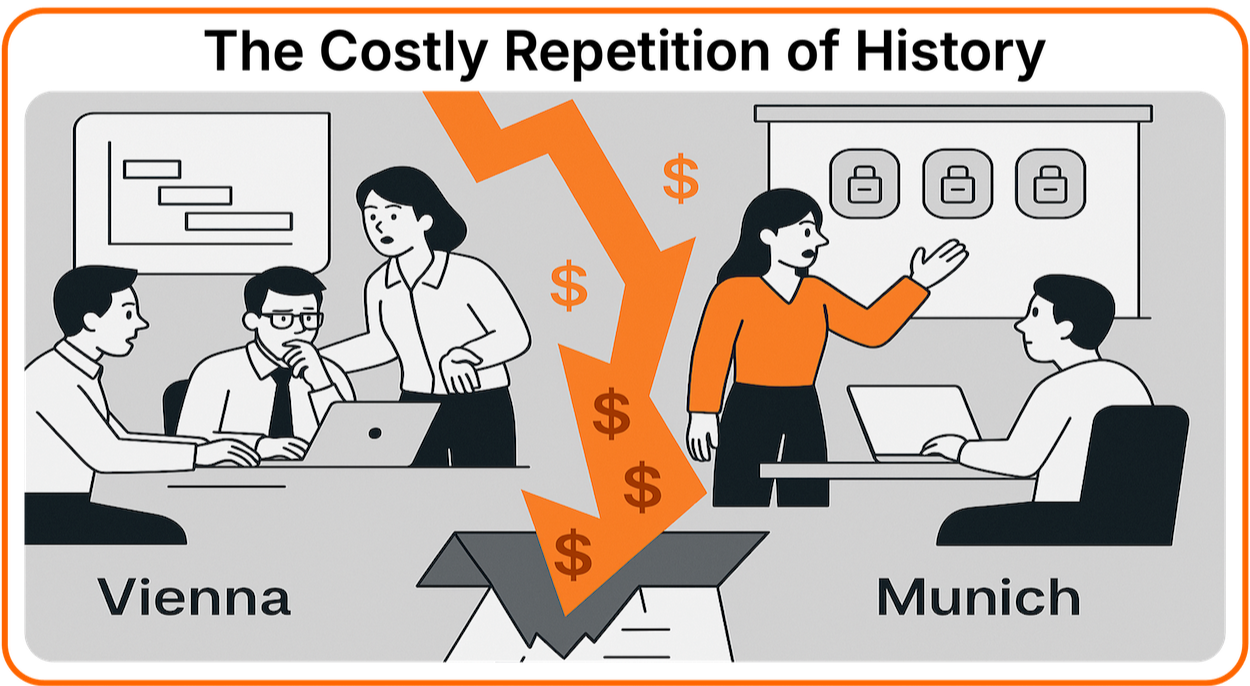
Story 2: The Costly Repetition of History
At NovaTech Industries, the product development team in Vienna was racing to meet a critical deadline on a major project—a new-generation industrial sensor system. They hit a snag when the sensor readings became erratic under specific conditions, threatening the project's timeline and client commitments.
What the Vienna team didn't know was that, just six months earlier, their colleagues in Munich had faced—and solved—the exact same issue during a similar project. The Munich team's struggle had lasted weeks, involving extensive trial and error, consultations with external experts, and significant financial expenditure.
But none of that valuable experience was captured effectively. Without structured documentation, these insights vanished into internal emails, presentations and scattered meeting notes—completely invisible to the Vienna team now desperate for answers.
As days turned into weeks, the Vienna team unknowingly repeated the Munich team's costly journey, duplicating their effort, time, and expenditure. The delay strained client relationships, incurred financial penalties, and consumed resources that could have been deployed elsewhere.
Months later, during a regional meeting, the two teams exchanged project updates. The moment the Munich engineers described their previous challenges, the Vienna team’s frustration was palpable. Both groups realized they had inadvertently squandered company resources by failing to effectively preserve and share critical knowledge.
Have you ever experienced these situations yourself, or perhaps recognized similar challenges within your organization? Such stories illustrate vividly how critical it is to preserve and structure knowledge effectively. When institutional expertise remains undocumented or inaccessible, companies inevitably face duplicated efforts, costly mistakes, operational disruptions, and hindered innovation. To sustain competitive advantage, streamline collaboration, and support informed decision-making, it's essential for organizations to capture, structure, and systematically manage their collective wisdom.
Vielen Dank!
Wir kontaktieren Sie in Kürze, um unsere Pilot-Fit-Session zu vereinbaren.
Bevor Sie gehen: Helfen Sie uns CogniCache auf Ihre Anforderungen abzustimmen.3 kurze Fragen – die Teilnahme ist freiwillig.
Teilen Sie CogniCache
Thank you.
We will contact you soon to schedule the pilot-fit session.
Before you go:
Help us to tailor CogniCache to your needs.3 quick questions, all optional.
In the meantime, we have prepared a strategic report on knowledge management that you can access below.
Or listen to a 20-minute summary of the report right here.
Share CogniCache
Thank you.
We have recorded your interest in CogniCache.Your status is active, guaranteeing you early access and priority onboarding.
Before you go:
Help us to tailor CogniCache to your needs.3 quick questions, all optional.
In the meantime, we have prepared a strategic report on knowledge management that you can access below.
Or listen to a 20-minute summary of the report right here.
Share CogniCache
Explore our FAQs
General
What is CogniCache? CogniCache is an AI-powered knowledge capture and transfer solution that helps organizations systematically extract, structure, and preserve critical expert knowledge. Through guided interviews, targeted follow-ups, and AI-powered structuring, it turns tacit know-how into reviewed, reusable knowledge assets and actionable insights.
Why is it called CogniCache? CogniCache stands for “Cognitive Cache,” reflecting our mission to store (cache) an organization’s collective wisdom (cognitive knowledge). We prevent valuable know-how from slipping through the cracks when key employees leave.
Is CogniCache only for large enterprises? No. CogniCache is valuable wherever critical expertise is concentrated in key people. Mid-sized and large organizations benefit especially from systematic knowledge capture across handovers, offboarding, projects, and ongoing knowledge transfer.
Does this replace our existing knowledge management tools? No. CogniCache complements existing knowledge systems by focusing on the hardest part: systematically capturing tacit expert knowledge and turning it into structured, reusable assets. It can be used standalone or alongside platforms such as SharePoint, Confluence, Notion, Google Workspace, and internal AI/RAG systems.
What kind of output does CogniCache generate? CogniCache creates structured, reusable knowledge assets tailored to the capture context, such as handover playbooks, process guides, lessons learned, technical documentation, and best-practice guides. Results can be reviewed, copied, and exported for further use.
How do teams benefit beyond knowledge preservation? CogniCache helps reduce repeated work, improve onboarding and offboarding, and make expertise easier to reuse. It also surfaces actionable insights, highlights opportunities to improve workflows, and recommends what knowledge to capture next.
Functionality & Use
How does CogniCache actually capture tacit knowledge? CogniCache combines guided AI interviews, targeted follow-up questions, knowledge-gap reviews, and intelligent structuring. It actively surfaces context, decision logic, exceptions, and practical know-how, then turns them into structured, reusable knowledge assets.
How do interviews with CogniCache work? CogniCache guides experts through a conversational interview using chat or voice. The AI adapts its questions to previous answers, asks targeted follow-ups, tracks capture progress, and identifies relevant knowledge gaps before generating the structured result.
Why does CogniCache use interviews to extract tacit knowledge? Interview-based elicitation is a proven way to surface expertise that people rarely document spontaneously. Methods from Cognitive Task Analysis and knowledge elicitation use adaptive probing to uncover decision cues, exceptions, reasoning, and mental models while removing the friction of starting from a blank page.
Which interview methods does CogniCache use to elicit tacit knowledge? CogniCache draws on established knowledge-elicitation techniques such as 5 Whys, Laddering, Critical Incident and Critical Decision approaches, exception probing, process mapping, what-if scenarios, and teach-back. The AI applies these principles dynamically to surface deeper context, decisions, edge cases, and practical know-how.
Can I customize the interview templates and questions? CogniCache currently provides pre-built templates for common knowledge-capture scenarios and also lets you start without a template, allowing the interview to be tailored to the specific topic and context. Custom template creation and management are planned for future releases.
Does CogniCache support multiple languages or industry-specific jargon? CogniCache can capture knowledge across different languages and domains. Its company glossary lets you define organization-specific terminology so the AI better understands internal language, abbreviations, concepts, and technical vocabulary.
What makes CogniCache better than basic transcription or summary tools? CogniCache actively extracts knowledge rather than simply recording it. Specialized AI interviews, targeted follow-ups, gap reviews, and structured output help surface what generic transcription and summarization tools often miss—including context, decision logic, exceptions, and tacit know-how.
How does CogniCache understand our company-specific terms and concepts? Organizations can add company-specific terminology and explanations to the CogniCache glossary. This context helps the AI understand internal language during interviews and produce more accurate, organization-specific knowledge assets.
Plans & Pricing
Which CogniCache offering is right for us? CogniCache is currently offered primarily through guided evaluations and pilots rather than fixed self-service plans. If you are exploring whether CogniCache fits your knowledge-capture challenge, start with a Pilot Fit & Demo. For a smaller controlled validation, an MVP Evaluation is a good next step. Organizations that want to test CogniCache with a real team and defined use case should start with an Enterprise Pilot.
What is the difference between an MVP Evaluation and an Enterprise Pilot? An MVP Evaluation is a smaller, controlled test designed to validate the core CogniCache workflow with a limited use case and non-sensitive or test knowledge. An Enterprise Pilot goes further by testing CogniCache in a real organizational setting with defined participants, tailored templates or workflows, success criteria, and hands-on support.
How does future pricing work? Final rollout pricing is not fixed yet and will depend on the validated operating model. Likely factors include the number of Knowledge Admins & Creators, usage volume, deployment requirements, security and compliance needs, and integrations. Subject-matter experts who contribute their knowledge during interviews are not expected to require a separate paid creator license.
Why doesn’t CogniCache currently offer fixed subscription plans? CogniCache is still in an early validation phase, and the current priority is to understand which workflows, deployment models, and capabilities create the most value for organizations. Rather than locking customers into premature pricing tiers, pilots help validate both the product and the right long-term commercial model.
What is the Enterprise Pilot and when should we use it? The Enterprise Pilot is designed for organizations that want to validate CogniCache in a real team setting before a broader rollout. Starting at €1,000, the pilot includes guided setup, tailored knowledge-capture workflows or templates, hands-on support, and agreed success criteria to evaluate adoption, output quality, and business value. Scope, duration, and final pricing depend on the specific use case.
Can we move from a pilot to a broader Enterprise rollout later? Yes. The pilot is intended as the first step toward a broader rollout. If CogniCache demonstrates value, the next phase can expand the number of users, use cases, governance capabilities, security requirements, deployment options, and integrations while keeping the captured knowledge reusable.
AI & Strategy
How does CogniCache support AI-driven search and RAG (Retrieval-Augmented Generation)? CogniCache turns expert know-how into structured, AI-ready knowledge assets that can be indexed and used by internal search, RAG, and AI assistants. Better-structured source knowledge helps these systems retrieve more relevant context and generate more reliable answers.
How does CogniCache support digital transformation, AI, and knowledge management strategies? CogniCache helps organizations preserve valuable expertise, reduce knowledge loss, and systematically strengthen their knowledge base over time. As part of a broader knowledge management strategy, it creates structured, reusable knowledge that supports continuity, onboarding, process improvement, internal search, RAG, and enterprise AI initiatives.
Adoption & Team Enablement
How can we encourage our teams to use CogniCache regularly? Make knowledge capture part of established workflows such as project wrap-ups, handovers, retrospectives, and expert offboarding. Define clear ownership and expectations, measure progress, and communicate the benefits—less repeated work, faster onboarding, and better access to expertise—so knowledge capture becomes a normal part of how teams work.
What features help motivate employees to contribute knowledge? CogniCache is designed to make knowledge capture easier through guided, low-friction interviews and visible progress. Planned team-momentum features such as achievements, streaks, challenges, and leaderboards will further encourage consistent participation and recognize contributions over time.
How do we officially integrate CogniCache into our existing processes? Embed CogniCache into recurring processes such as project closure, retrospectives, onboarding, handovers, and expert offboarding. Define clear knowledge-capture responsibilities and KPIs so that capturing critical expertise becomes an expected and measurable part of everyday work.
Can we track and reward knowledge contribution? Expanded analytics and team-momentum capabilities are planned to help organizations understand capture activity, knowledge coverage, and team progress. These insights can support recognition, goals, challenges, and other incentives that encourage consistent knowledge sharing.
What’s the best way to make the most of CogniCache? Treat knowledge capture as a continuous cycle: embed it into workflows, define success, capture critical expertise, recognize participation, and repeat. Use the resulting knowledge in systems such as Confluence or SharePoint and continuously identify gaps and opportunities to strengthen your organizational knowledge base.
What’s the best team setup to get the most out of CogniCache? Define clear ownership. A Knowledge Admin, typically a team lead or manager, prioritizes what should be captured and monitors the process, while a Knowledge Creator coordinates and conducts capture sessions with the relevant subject-matter experts. This keeps knowledge capture structured, accountable, and sustainable across the team.
Analytics & Optimization
Is there a way to measure how well teams are using CogniCache? Expanded analytics are planned to provide visibility into capture activity, knowledge quality, depth, coverage, and team progress—helping organizations understand where their knowledge base is strong and where further capture is needed.
Can CogniCache identify knowledge gaps? Yes. CogniCache identifies relevant gaps during individual capture sessions and uses captured knowledge to recommend valuable next captures. Planned analytics will extend this across the broader knowledge base, helping organizations systematically uncover blind spots and strengthen knowledge coverage over time.
Deployment & Integration
Do we need any coding skills or special infrastructure to use CogniCache? No. CogniCache is designed for straightforward business use without coding. Captured knowledge can be reviewed, exported, and used in existing systems such as Confluence, SharePoint, Notion, or internal AI solutions.
Where is our data stored, and can we choose hosting regions? CogniCache currently uses EU-based cloud infrastructure with data protection in mind. For enterprise pilots and future rollouts, data residency, private cloud, and other deployment requirements can be discussed based on your organization’s security and IT policies.
How secure is the data captured by CogniCache? CogniCache is designed with security and data protection as core principles, including secure data transmission, controlled access, tenant separation, and auditable processing. Additional enterprise security capabilities are being expanded as the platform moves toward broader deployments.
Is CogniCache compliant? CogniCache is designed with leading data protection, security, and responsible-AI requirements in mind, including GDPR and the EU AI Act, as well as relevant UK and US requirements and frameworks such as NIST AI RMF and ISO 27001. Specific compliance and deployment requirements are assessed together with enterprise customers rather than claiming blanket certification.
Getting Started
How do we get started or request a demo? Start with a free Pilot Fit & Demo to discuss your use case, see CogniCache in action, and determine the right next step. From there, organizations can move into an MVP Evaluation or a structured Enterprise Pilot. If you are not ready for a pilot yet, you can join the Founders Club for updates and early access.
Privacy Policy (English & Deutsch)
Privacy Policy for the EU, UK & USA
Last Updated: 15/03/2026This privacy policy explains how we handle your personal data in accordance with the General Data Protection Regulation (GDPR) and other applicable privacy regulations, including the California Consumer Privacy Act (CCPA) and the California Privacy Rights Act (CPRA). For purposes of EU data protection law, Dr. Andreas Bachmeier is the data controller of your personal information.1. What Information We Collect- Cookies & Usage Data: We use cookies to enhance your experience. Tools like Google Analytics help us understand landing page usage.
- Contact Information: Name, email, and company details provided via contact forms or direct email.
- Communication & Interview Data: If you participate in interviews or meetings, we collect meeting notes, feedback, and, only with your explicit prior consent, audio/video recordings.
- Technical Log Data: IP addresses and technical logs processed by our IT systems (Google Workspace) for security and operational stability.2. How We Use Your Information- Marketing & Newsletters: We use your contact details to send updates about CogniCache. This is based on your explicit consent (Art. 6(1)(a) GDPR).
- Business Operations, Research & Development: We process data from meetings and interviews to improve our software. This is based on our legitimate interest in product development (Art. 6(1)(f) GDPR) or pre-contractual measures (Art. 6(1)(b) GDPR).
- Business Communication, Documentation & AI-Assisted Processing: We use Google Workspace for secure business communication, document storage, documentation, collaboration, and integrated features that support drafting, summarization, and analysis of business and client-related information. This processing is carried out as necessary for responding to inquiries, preparing and managing business relationships, internal administration, documentation, and IT security, and is based on Art. 6(1)(b) GDPR and, where applicable, Art. 6(1)(f) GDPR.3. Third-Party Sharing & International Transfers We share information with trusted service providers:- Brevo: For email marketing and lead management.
- Google Workspace: For internal storage, email communication, documentation, document collaboration, and related business information processing.
Processor agreements: Where required by applicable law, we have concluded data processing agreements with our service providers.Security & Compliance: Our providers are ISO 27001 certified and utilize multi-factor authentication.
International Transfers: While we prioritize EU-based storage, some data may be processed in the USA. These transfers are protected under the EU-U.S. Data Privacy Framework or standard contractual clauses (SCCs) to ensure a level of protection equivalent to the GDPR.4. Legal Basis for Processing- Consent: For non-essential cookies and marketing communications.
- Contract/Pre-contractual: For responding to specific inquiries or preparing business relationships.
- Legitimate Interest: For product optimization, user research, and ensuring the security of our IT infrastructure.5. Data Retention
We retain your personal data only as long as necessary:- Marketing data: Until you withdraw consent.
- Business communication/Interviews: Generally for 3 years following the end of the year in which the last contact occurred, to comply with standard statutory limitation periods, unless longer retention is required by tax or commercial law.6. Consent and Cookie Handling
Non‑essential cookies (e.g., Google Analytics) are only loaded after you provide explicit consent via our cookie banner.7. Your Rights You have the right to:- Access, Rectification, and Deletion of your data.
- Data Portability (structured, machine-readable format).
- Object to processing based on legitimate interests.
- Withdraw Consent at any time (via email).
- Lodge a complaint with a supervisory authority (e.g., Berlin Commissioner for Data Protection).
- California Residents: You have specific rights under CCPA/CPRA to request disclosure, deletion, and to opt-out of the "sale" or "sharing" of personal info (we do not sell your data).8. How to Contact Us
Email: [email protected]
Address: Dr. Andreas Bachmeier, Finnländische Str. 7, 10439 Berlin, Germany.We aim to respond to all requests within one month.
Datenschutzerklärung
Letzte Aktualisierung: 15/03/2026Diese Datenschutzerklärung erläutert, wie wir Ihre personenbezogenen Daten in Übereinstimmung mit der Datenschutz-Grundverordnung (DSGVO) und anderen anwendbaren Datenschutzvorschriften, einschließlich des California Consumer Privacy Act (CCPA) und des California Privacy Rights Act (CPRA), verarbeiten. Für die Zwecke des EU-Datenschutzrechts ist Dr. Andreas Bachmeier der Verantwortliche für die Verarbeitung Ihrer personenbezogenen Daten.1. Welche Informationen wir erheben- Cookies & Nutzungsdaten: Wir verwenden Cookies, um Ihre Nutzererfahrung zu verbessern. Tools wie Google Analytics helfen uns, die Nutzung unserer Landingpages zu verstehen.
- Kontaktdaten: Name, E-Mail-Adresse und Unternehmensangaben, die über Kontaktformulare oder per direkter E-Mail bereitgestellt werden.
- Kommunikations- & Interviewdaten: Wenn Sie an Interviews oder Meetings teilnehmen, erfassen wir Gesprächsnotizen und Feedback sowie – nur mit Ihrer vorherigen ausdrücklichen Einwilligung – Audio-/Videoaufzeichnungen.
- Technische Protokolldaten: IP-Adressen und technische Logs, die von unseren IT-Systemen (Google Workspace) aus Sicherheits- und Betriebsstabilitätsgründen verarbeitet werden.2. Wie wir Ihre Informationen verwenden- Marketing & Newsletter: Wir verwenden Ihre Kontaktdaten, um Ihnen Updates zu CogniCache zu senden. Dies erfolgt auf Grundlage Ihrer ausdrücklichen Einwilligung (Art. 6 Abs. 1 lit. a DSGVO).
- Geschäftsprozesse, Forschung & Entwicklung: Wir verarbeiten Daten aus Meetings und Interviews zur Verbesserung unserer Software. Dies erfolgt auf Grundlage unseres berechtigten Interesses an der Produktentwicklung (Art. 6 Abs. 1 lit. f DSGVO) oder im Rahmen vorvertraglicher Maßnahmen (Art. 6 Abs. 1 lit. b DSGVO).
- Geschäftskommunikation, Dokumentation & KI-gestützte Verarbeitung: Wir nutzen Google Workspace für sichere geschäftliche Kommunikation, Dokumentenspeicherung, Dokumentation, Zusammenarbeit sowie integrierte Funktionen zur Unterstützung von Entwürfen, Zusammenfassungen und Analysen geschäfts- und kundenbezogener Informationen. Diese Verarbeitung erfolgt, soweit erforderlich, zur Beantwortung von Anfragen, zur Anbahnung und Durchführung von Geschäftsbeziehungen, zur internen Administration, Dokumentation und IT-Sicherheit und basiert auf Art. 6 Abs. 1 lit. b DSGVO sowie, soweit anwendbar, auf Art. 6 Abs. 1 lit. f DSGVO.3. Weitergabe an Dritte & internationale Datenübermittlungen
Wir teilen Informationen mit vertrauenswürdigen Dienstleistern:- Brevo: Für E-Mail-Marketing und Lead-Management.
- Google Workspace: Für interne Speicherung, E-Mail-Kommunikation, Dokumentation, Zusammenarbeit an Dokumenten sowie die damit verbundene Verarbeitung geschäftsbezogener Informationen.
Auftragsverarbeitung: Soweit gesetzlich erforderlich, haben wir mit unseren Dienstleistern Auftragsverarbeitungsverträge bzw. Datenverarbeitungsvereinbarungen abgeschlossen.Sicherheit & Compliance:
Unsere Dienstleister sind nach ISO 27001 zertifiziert und nutzen Multi-Faktor-Authentifizierung.
Internationale Übermittlungen: Obwohl wir eine Speicherung innerhalb der EU priorisieren, können Daten in den USA verarbeitet werden. Diese Übermittlungen sind durch das EU-US Data Privacy Framework oder Standardvertragsklauseln (SCCs) abgesichert, um ein der DSGVO gleichwertiges Schutzniveau zu gewährleisten.4. Rechtsgrundlagen der Verarbeitung- Einwilligung: Für nicht notwendige Cookies und Marketingkommunikation.
- Vertrag/vorvertragliche Maßnahmen: Für die Beantwortung konkreter Anfragen oder die Vorbereitung von Geschäftsbeziehungen.
- Berechtigtes Interesse: Für Produktoptimierung, Nutzerforschung und die Sicherstellung der Sicherheit unserer IT-Infrastruktur.5. Speicherdauer
Wir speichern Ihre personenbezogenen Daten nur so lange, wie es erforderlich ist:- Marketingdaten: Bis Sie Ihre Einwilligung widerrufen.
- Geschäftskommunikation/Interviews: In der Regel 3 Jahre nach Ablauf des Jahres, in dem der letzte Kontakt stattgefunden hat, zur Einhaltung gesetzlicher Verjährungsfristen, sofern keine längere Aufbewahrung aufgrund steuer- oder handelsrechtlicher Vorgaben erforderlich ist.6. Einwilligung und Cookie-Handhabung
Nicht notwendige Cookies (z. B. Google Analytics) werden erst nach Ihrer ausdrücklichen Einwilligung über unser Cookie-Banner geladen.7. Ihre Rechte
Sie haben das Recht auf:- Auskunft, Berichtigung und Löschung Ihrer Daten.
- Datenübertragbarkeit (in einem strukturierten, gängigen und maschinenlesbaren Format).
- Widerspruch gegen Verarbeitungen auf Grundlage berechtigter Interessen.
- Widerruf Ihrer Einwilligung jederzeit per Email.
- Beschwerde bei einer Aufsichtsbehörde (z. B. Berliner Beauftragte für Datenschutz und Informationsfreiheit).
- Einwohner Kaliforniens: Sie haben besondere Rechte nach CCPA/CPRA auf Auskunft, Löschung sowie Widerspruch gegen den „Verkauf“ oder das „Teilen“ personenbezogener Daten (wir verkaufen Ihre Daten nicht).8. Kontakt
E-Mail: [email protected]
Adresse: Dr. Andreas Bachmeier, Finnländische Str. 7, 10439 Berlin, Deutschland.Wir bemühen uns, alle Anfragen innerhalb eines Monats zu beantworten.
Terms Of Service (English & Deutsch)
Terms of Service for the EU, UK & USA
Last updated: 03/04/2026These Terms of Service (“Terms”) govern your access to and use of CogniCache (“the Service”), operated by Dr. Andreas Bachmeier (“we”, “us”, or “our”). By accessing or using CogniCache, you agree to these Terms.
If you do not agree, please do not use the Service.1. Service Description, Deployment Models & MVP / Early Access Status
CogniCache is a knowledge capture application designed to help organizations preserve and structure expert knowledge.
CogniCache may be provided in different deployment models, including:
a) a provider-hosted SaaS / MVP / early access environment operated by us; and
b) a customer-hosted deployment operated within the customer’s own infrastructure, subject to separate agreement and technical feasibility.
CogniCache is currently provided in an MVP / early access stage. This means that features may change, evolve, or be discontinued, and availability, performance, and functionality are not guaranteed.Scope of Use – Hosted MVP / Early Access Environment
Unless otherwise expressly agreed in writing, the provider-hosted MVP / early access environment is intended primarily for functional testing, evaluation, demonstrations, and pilot preparation.By default, this hosted MVP environment is not intended for the upload, processing, or storage of:
- confidential business information,
- trade secrets,
- personal data,
- special categories of personal data within the meaning of Art. 9 GDPR,
- or other sensitive, regulated, or security-critical information.Company-Approved Use
Notwithstanding the above, a customer may decide to use the hosted MVP / early access environment for real enterprise pilot scenarios, including non-public internal knowledge, provided that the customer has completed its own internal review, risk assessment, and approval process and has authorized such use under its own policies and governance requirements.The customer is solely responsible for determining whether the hosted MVP environment is suitable for its intended use case, data categories, and compliance requirements. We do not independently verify or guarantee that the hosted MVP environment satisfies the customer’s internal security, legal, regulatory, or procurement requirements unless this is expressly agreed in writing.Customer-Hosted Deployment
As an alternative deployment path, CogniCache may also be deployed within the customer’s own digital infrastructure or controlled environment, subject to separate agreement, implementation scope, and technical feasibility. Any such deployment may be governed by additional contractual terms, including but not limited to service descriptions, security arrangements, data processing terms, and support commitments.Liability – MVP / Early Access
Any use of the hosted MVP / early access environment for confidential, sensitive, personal, or otherwise restricted information without the customer’s own prior approval and authorization is at the user’s and customer’s own risk. To the maximum extent permitted by law, the provider assumes no liability for damages resulting from use of the hosted MVP environment contrary to this Section 1.2. Eligibility
You must be at least 18 years old and authorized to act on behalf of your organization to use the Service.3. Accounts & Access
You are responsible for maintaining the confidentiality of your access credentials.
You agree not to share access credentials with unauthorized parties.
We reserve the right to suspend or terminate access if these Terms are violated or if use poses a security or legal risk.4. Acceptable Use
You agree not to:
use the Service for unlawful purposes;
upload, process, or store content you do not have the right to use;
use the hosted MVP / early access environment for confidential, sensitive, or regulated information without your organization’s prior internal approval and authorization;
attempt to reverse engineer, disrupt, or misuse the Service;
interfere with system security or availability.We may suspend access if misuse is detected.5. Content & Data Ownership
You retain full ownership of all content you provide to CogniCache.
We do not claim intellectual property rights over your content.
Your content is processed solely to provide the Service and related functionality, in accordance with our Privacy Policy and any separately agreed contractual terms.
Where a customer-hosted deployment is used, data handling may also be subject to the customer’s own infrastructure, policies, and separately agreed implementation terms.6. AI-Generated Output
CogniCache uses AI-assisted methods to help capture, structure, and summarize knowledge.
AI-generated outputs may require human review.
You remain responsible for how outputs are used, interpreted, validated, or relied upon.
CogniCache does not guarantee completeness, correctness, or suitability for specific purposes.7. Availability & Changes
We may modify, suspend, or discontinue parts of the Service at any time, especially during MVP / early access, with or without notice.
Deployment options, features, and support levels may differ between the hosted MVP environment and customer-hosted deployments.8. Disclaimer of Warranties
The Service is provided “as is” and “as available”, without warranties of any kind, whether express or implied.
To the maximum extent permitted by law, we do not warrant that the hosted MVP / early access environment is suitable for confidential, sensitive, regulated, or production-critical workloads unless expressly agreed in writing.9. Limitation of Liability
To the maximum extent permitted by law, we shall not be liable for indirect, incidental, special, or consequential damages arising from or related to your use of the Service.
In particular, and without limitation, we shall not be liable for damages arising from the use of the hosted MVP / early access environment for confidential, sensitive, personal, or regulated information unless such use has been expressly agreed by us in writing as part of a separate contractual arrangement.
Nothing in these Terms excludes liability where such exclusion is prohibited by applicable law.10. Termination
You may stop using the Service at any time.
We may terminate or suspend access for violations of these Terms.
Data handling upon termination follows our Privacy Policy and any separately agreed contractual terms.11. Governing Law
These Terms are governed by the laws of Germany, excluding conflict-of-law principles. Jurisdiction lies with the courts of Germany, to the extent permitted by law.12. Contact Information
For questions regarding these Terms, please contact:
Dr. Andreas Bachmeier
Email: [email protected]
Address: Finnländische Str. 7, 10439 Berlin, Germany
Nutzungsbedingungen (Terms of Service)
Letzte Aktualisierung: 03/04/2026Diese Nutzungsbedingungen („Bedingungen“) regeln Ihren Zugriff auf und Ihre Nutzung von CogniCache („der Service“), betrieben von Dr. Andreas Bachmeier („wir“, „uns“ oder „unser“). Durch den Zugriff auf oder die Nutzung von CogniCache stimmen Sie diesen Bedingungen zu.
Wenn Sie diesen Bedingungen nicht zustimmen, nutzen Sie den Service bitte nicht.1. Leistungsbeschreibung, Bereitstellungsmodelle & MVP- / Early-Access-Status
CogniCache ist eine Anwendung zur Erfassung von Wissen, die Organisationen dabei unterstützt, Expertenwissen zu bewahren und zu strukturieren.
CogniCache kann in unterschiedlichen Bereitstellungsmodellen angeboten werden, darunter:
a) eine von uns betriebene SaaS- / MVP- / Early-Access-Umgebung; und
b)eine kundenseitig gehostete Bereitstellung innerhalb der eigenen Infrastruktur des Kunden, vorbehaltlich gesonderter Vereinbarung und technischer Umsetzbarkeit.CogniCache befindet sich derzeit in einem MVP- / Early-Access-Stadium. Das bedeutet, dass Funktionen geändert, weiterentwickelt oder eingestellt werden können und Verfügbarkeit, Performance sowie Funktionalität nicht garantiert werden.Nutzungsumfang – Gehostete MVP- / Early-Access-Umgebung
Soweit nicht ausdrücklich schriftlich etwas anderes vereinbart wurde, ist die von uns gehostete MVP- / Early-Access-Umgebung in erster Linie für funktionale Tests, Evaluierungen, Demonstrationen und die Vorbereitung von Pilotprojekten bestimmt.Diese gehostete MVP-Umgebung ist standardmäßig nicht für das Hochladen, Verarbeiten oder Speichern folgender Informationen vorgesehen:
- vertrauliche Geschäftsinformationen,
- Geschäftsgeheimnisse,
- personenbezogene Daten,
- besondere Kategorien personenbezogener Daten im Sinne von Art. 9 DSGVO,
. oder sonstige sensible, regulierte oder sicherheitskritische Informationen.Unternehmensseitig freigegebene Nutzung
Ungeachtet des Vorstehenden kann sich ein Kunde entscheiden, die gehostete MVP- / Early-Access-Umgebung für reale Enterprise-Pilot-Szenarien einschließlich nicht öffentlicher interner Wissensinhalte zu nutzen, sofern der Kunde zuvor seine eigene interne Prüfung, Risikobewertung und Freigabe durchgeführt und eine solche Nutzung nach seinen eigenen Richtlinien und Governance-Vorgaben genehmigt hat.Der Kunde ist allein dafür verantwortlich zu beurteilen, ob die gehostete MVP-Umgebung für seinen beabsichtigten Anwendungsfall, die betroffenen Datenkategorien und seine Compliance-Anforderungen geeignet ist. Wir prüfen nicht eigenständig und garantieren nicht, dass die gehostete MVP-Umgebung die internen Sicherheits-, Rechts-, Regulierungs- oder Beschaffungsanforderungen des Kunden erfüllt, sofern dies nicht ausdrücklich schriftlich vereinbart wurde.Kundenseitig gehostete Bereitstellung
Als alternativer Bereitstellungsweg kann CogniCache auch innerhalb der digitalen Infrastruktur oder einer kontrollierten Umgebung des Kunden bereitgestellt werden, vorbehaltlich gesonderter Vereinbarung, Implementierungsumfang und technischer Umsetzbarkeit. Eine solche Bereitstellung kann zusätzlichen vertraglichen Regelungen unterliegen, insbesondere zu Leistungsbeschreibung, Sicherheitsmaßnahmen, Auftragsverarbeitung und Support.Haftung – MVP / Early Access
Jede Nutzung der gehosteten MVP- / Early-Access-Umgebung für vertrauliche, sensible, personenbezogene oder anderweitig besonders geschützte Informationen ohne vorherige interne Freigabe und Autorisierung des Kunden erfolgt auf eigenes Risiko des Nutzers bzw. Kunden. Soweit gesetzlich zulässig, übernimmt der Anbieter keine Haftung für Schäden, die aus einer Nutzung der gehosteten MVP-Umgebung entgegen diesem Abschnitt 1 entstehen.2. Teilnahmeberechtigung
Sie müssen mindestens 18 Jahre alt sein und berechtigt sein, im Namen Ihrer Organisation zu handeln, um den Service nutzen zu dürfen.3. Konten & Zugriff
Sie sind für die Wahrung der Vertraulichkeit Ihrer Zugangsdaten verantwortlich.
Sie verpflichten sich, Zugangsdaten nicht an unbefugte Dritte weiterzugeben.
Wir behalten uns das Recht vor, den Zugriff auszusetzen oder zu beenden, wenn diese Bedingungen verletzt werden oder die Nutzung ein Sicherheits- oder Rechtsrisiko darstellt.4. Zulässige Nutzung
Sie verpflichten sich, Folgendes zu unterlassen:
- den Service für rechtswidrige Zwecke zu nutzen;
- Inhalte hochzuladen, zu verarbeiten oder zu speichern, zu deren Nutzung Sie nicht berechtigt sind;
- die gehostete MVP- / Early-Access-Umgebung ohne vorherige interne Freigabe und Autorisierung Ihrer Organisation für vertrauliche, sensible oder regulierte Informationen zu nutzen;
- den Service zu reverse-engineeren, zu stören oder missbräuchlich zu verwenden;
- die Systemsicherheit oder -verfügbarkeit zu beeinträchtigen.Bei festgestelltem Missbrauch können wir den Zugriff aussetzen.5. Inhalte & Datenhoheit
Sie behalten das vollständige Eigentum an allen Inhalten, die Sie in CogniCache bereitstellen.
Wir beanspruchen keine geistigen Eigentumsrechte an Ihren Inhalten.
Ihre Inhalte werden ausschließlich zur Bereitstellung des Services und der damit verbundenen Funktionen gemäß unserer Datenschutzerklärung sowie etwaigen gesondert vereinbarten vertraglichen Regelungen verarbeitet.Bei einer kundenseitig gehosteten Bereitstellung kann die Datenverarbeitung zusätzlich den jeweiligen Infrastrukturen, Richtlinien und gesondert vereinbarten Implementierungsbedingungen des Kunden unterliegen.6. KI-generierte Ausgaben
CogniCache nutzt KI-gestützte Methoden zur Erfassung, Strukturierung und Zusammenfassung von Wissen.
KI-generierte Ausgaben können eine menschliche Prüfung erfordern.
Sie bleiben verantwortlich für die Nutzung, Interpretation, Validierung und Verlässlichkeit der Ausgaben.
CogniCache übernimmt keine Garantie für Vollständigkeit, Richtigkeit oder Eignung für bestimmte Zwecke.7. Verfügbarkeit & Änderungen
Wir können Teile des Services jederzeit ändern, aussetzen oder einstellen, insbesondere während der MVP- / Early-Access-Phase, mit oder ohne vorherige Ankündigung.
Bereitstellungsmodelle, Funktionen und Support-Level können sich zwischen der gehosteten MVP-Umgebung und kundenseitig gehosteten Bereitstellungen unterscheiden.8. Haftungsausschluss
Der Service wird „wie besehen“ und „wie verfügbar“ bereitgestellt, ohne jegliche ausdrückliche oder stillschweigende Gewährleistungen.
Soweit gesetzlich zulässig, gewährleisten wir nicht, dass die gehostete MVP- / Early-Access-Umgebung für vertrauliche, sensible, regulierte oder produktionskritische Anwendungsfälle geeignet ist, sofern dies nicht ausdrücklich schriftlich vereinbart wurde.9. Haftungsbeschränkung
Soweit gesetzlich zulässig, haften wir nicht für indirekte, zufällige, besondere oder Folgeschäden, die aus oder im Zusammenhang mit der Nutzung des Services entstehen.
Insbesondere und ohne Einschränkung haften wir nicht für Schäden, die aus der Nutzung der gehosteten MVP- / Early-Access-Umgebung für vertrauliche, sensible, personenbezogene oder regulierte Informationen entstehen, sofern eine solche Nutzung nicht ausdrücklich schriftlich im Rahmen einer gesonderten vertraglichen Vereinbarung mit uns vereinbart wurde.
Zwingende gesetzliche Haftungstatbestände bleiben unberührt.10. Beendigung
Sie können die Nutzung des Services jederzeit beenden.
Wir können den Zugriff bei Verstößen gegen diese Bedingungen aussetzen oder beenden.
Die Datenverarbeitung im Falle einer Beendigung richtet sich nach unserer Datenschutzerklärung sowie etwaigen gesondert vereinbarten vertraglichen Regelungen.11. Anwendbares Recht
Diese Bedingungen unterliegen dem Recht der Bundesrepublik Deutschland unter Ausschluss des Kollisionsrechts. Gerichtsstand sind, soweit gesetzlich zulässig, die Gerichte in Deutschland.12. Kontaktinformationen
Bei Fragen zu diesen Bedingungen kontaktieren Sie bitte:
Dr. Andreas Bachmeier
E-Mail: [email protected]
Adresse: Finnländische Str. 7, 10439 Berlin, Deutschland
CogniCache
Dr. Andreas Bachmeier
Finnlaendische Str. 7
10439 Berlin
Germany
Mail: [email protected]

About CogniCache

Dr. Andreas T. Bachmeier
Founder & CEO of CogniCache
"Our solutions capture critical knowledge to empower your organization’s future."
Founded in 2024 in Berlin, CogniCache is built by a small, dedicated team with deep corporate experience. We’ve lived the daily reality of modern organizations: critical know-how walking out the door, teams duplicating work, and valuable information being impossible to find when it matters most.That firsthand pain is our motivation. Our north star is capturing critical knowledge and wisdom to empower every organization’s future.We are an AI-first company. We leverage Generative AI heavily across both our platform and our daily processes, not as a gimmick, but as a core productivity and quality lever. At the same time, we take responsible use seriously: knowledge is sensitive, nuance matters, and trust is non-negotiable. That is why we design for human oversight, clear review steps, and reliable outputs, especially when captured expertise becomes the foundation for internal search and RAG workflows.Compliance is foundational to how we operate and how we build. This includes strong data protection and privacy practices for our products and daily operations (for example, GDPR compliance) as well as responsible AI principles and integration of evolving requirements (for example, alignment with the EU AI Act where applicable). We treat trust, security, and governance as fundamentals, not afterthoughts.We also operate lean by design. “Lean” for us means eliminating waste: fewer sidetracks, less overhead, and faster learning cycles, so we can spend our time where it counts, understanding real client needs and turning them into the best possible solution. It also means a focused core team with tight alignment and quick decisions, extended by additional specialists when needed, without bloating the organization or adding unnecessary coordination layers.CogniCache transforms tacit expertise into structured, AI-ready assets through guided interviews, intelligent structuring, and human validation. The result is a reliable foundation for knowledge retrieval, better onboarding, and higher-quality AI outputs grounded in real organizational wisdom.Our solution is more than documentation. It is a specialized knowledge capture system that preserves critical know-how, reduces rework, and frees teams to focus on what truly matters.If this resonates, follow our journey. The future of knowledge capture is being written now. Let’s build it right, together.